

By Cisco Sa, founder of SilentDisco.de, pioneer of the silent‑disco concept, and creator of the Silent Tunes app.
Summary: What looks like quiet isolation is, in truth, a new form of togetherness. Silent discos break old rituals, dissolve cultural prejudices, and create a space where people feel freer, braver, and more connected than ever before.
Silent discos are one of the great paradoxes of modern party culture.
On paper, the concept sounds like the ultimate form of isolation:
a room full of people, each wearing headphones, each in their own sound world.
This skepticism isn’t superficial.
It’s cultural, emotional, and tied to identity.
I’ve watched this scene play out hundreds of times, in hundreds of rooms, and the pattern is remarkably consistent. The skepticism arrives before the music does. Someone stands at the edge with their arms crossed, looking around as though they were invited to a party and accidentally walked into an experiment. There’s usually a joke about the headphones, a complaint about the missing speakers, some version of „this isn’t a real party.“
And I understand it. What they’re defending isn’t really the speaker. It’s an idea of what a party is supposed to feel like — an idea we’ve all been handed without ever choosing it.
The wall of skepticism, and why it always falls
For generations, we’ve been taught that collective energy comes from collective sound. The speakers sit at the front of the room, the DJ decides what comes out of them, the bass moves through the floor and through every body standing on it, and everyone submits to the same thing at the same moment. That arrangement is so familiar we rarely notice how much of the atmosphere it’s actually manufacturing for us. The room arrives already charged. You don’t have to make it alive — the sound system does that on your behalf.
Which is exactly why the first reaction to a silent disco can be so sharp. Take away the speakers, and for a moment it can feel as though you’ve taken away the thing that was supposed to make the room a party in the first place. There’s no wall of sound announcing that something important is happening. There’s no bass telling everyone, before they’ve decided for themselves, that this is where the energy is. There’s just a room full of people — which means, for a few uncomfortable seconds, the room has to ask something of them.
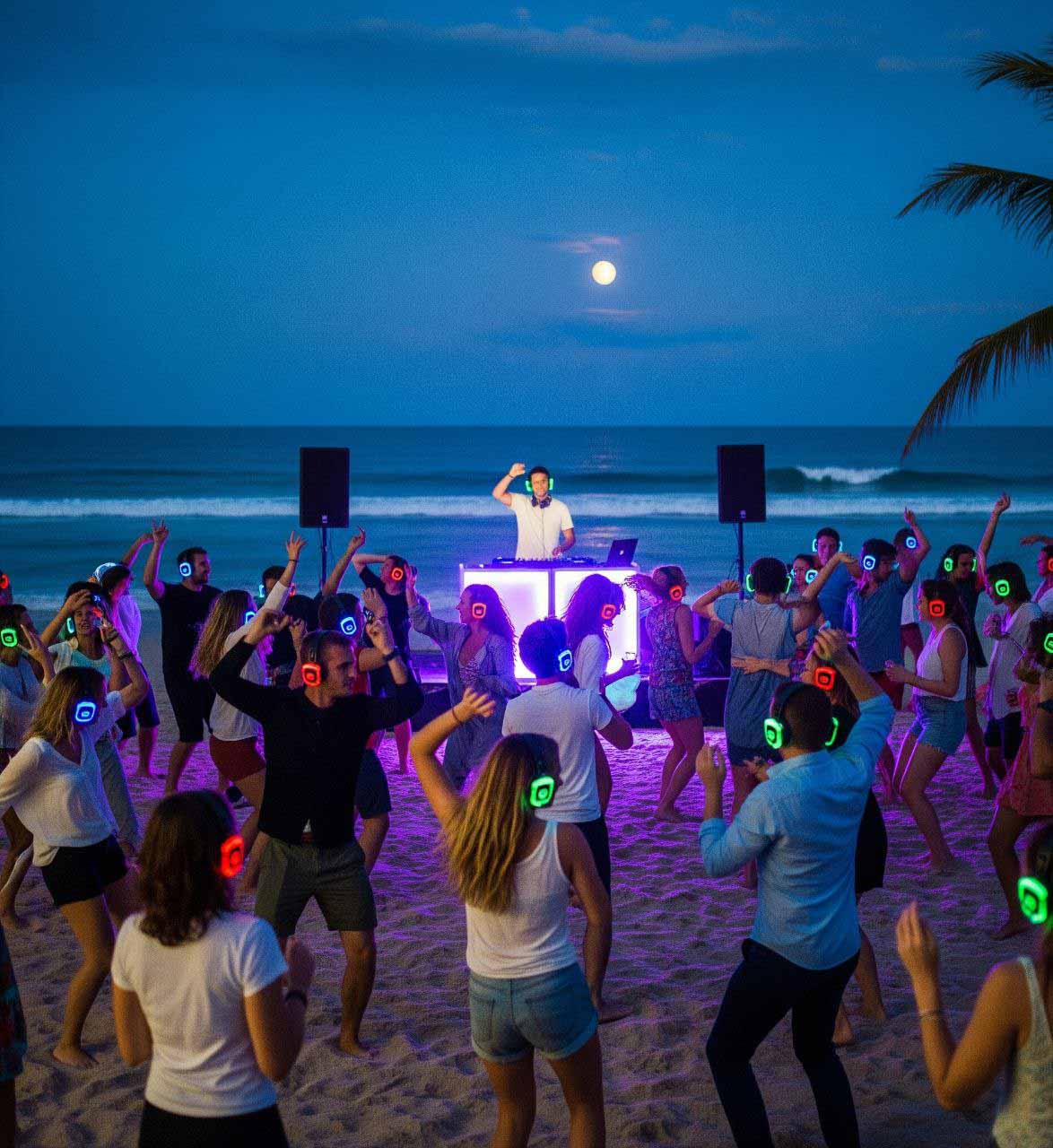
What happens next is the part I never get tired of watching. The energy doesn’t disappear. It moves — out of the equipment and into the people. You see it first in the small things: someone starts moving, someone else notices, a group across the room suddenly bursts into song, another group switches channel because they’ve seen something happening over there. People who were standing still begin to participate, not because a speaker forced them into the same rhythm, but because they’re watching one another and responding in real time. The atmosphere stops being something delivered to the room and becomes something the room produces itself. That distinction sounds theoretical until you’re standing in the middle of it — then it’s almost impossible not to notice.
The bass used to carry the room. Now the room carries itself. And that may be exactly why the loudest skeptics so often become the most devoted converts: they discover that the thing they were afraid of losing — the feeling of being part of something larger — was never located entirely inside the speakers to begin with. The speakers were only ever one way of producing it. The crowd was always the other, quieter engine running underneath.
Talking without shouting
In a conventional club, volume draws an invisible boundary around every conversation. To speak to the person beside you, you have to cross it by shouting — you lean in, they lean in, you repeat yourself, they still mishear you, and eventually the conversation becomes work nobody signed up for. We accept this as a fact of nightlife because we’ve accepted the underlying architecture of nightlife: the music comes first, and everything else has to negotiate with it.
A silent disco quietly reverses that hierarchy. The music stays available, but it’s no longer imposed on the entire physical space. Want to talk? Lower the headphones. The room hasn’t disappeared. The people haven’t disappeared. You haven’t had to abandon the dance floor for some quieter corner of the building just to hear another human being speak — you’re still there, still part of the night, still surrounded by the same people, except now you can actually hear them. Then you put the headphones back on and vanish into the music again.
What that reveals, I think, is something bigger than convenience: being together doesn’t require doing exactly the same thing at exactly the same moment. Sometimes it just means having enough freedom to move between different modes of participation — dancing, talking, listening, watching, disappearing, returning — without ever having to leave the group to do it. None of those choices cost you the room. That’s freedom within the crowd, not freedom from it.
What the crowd gives you that headphones alone never could
This is also why I don’t think the multiple channels create the isolation people expect going in. At first the idea sounds almost absurd — a room full of people, all wearing headphones, potentially locked into completely different songs. Surely that has to make the experience less collective. But that assumption only holds if collective experience requires identical experience, and I’m no longer convinced it does.
The crowd doesn’t need to hear the same thing to stay aware of each other. If anything, the differences become part of what everyone’s watching. The color of someone’s headphones tells you what they’re tuned to. A sudden shift in color rippling across a group tells you something just happened over there. One cluster starts singing along to a nineties hit while another keeps dancing to something else entirely — you can’t hear the difference, but you can see it, and that visibility is what turns a private choice into a social event. What are they hearing? Why are they all moving like that? Should I switch? The individual choice becomes visible, and the moment it becomes visible, it becomes shared. You can choose your own soundtrack without building your own world.
And it gets even more obvious in the moments when people take the headphones off entirely. What they hear then is usually ridiculous: someone singing badly, someone else singing an entirely different song, tempos that don’t match, clapping that lands nowhere near the beat, laughter breaking out for no clear reason. A conventional sound system gives a crowd a kind of acoustic mask — it smooths everything together, makes the room feel bigger and more powerful and more in control, and gives everyone somewhere to hide inside the noise. A silent disco occasionally lifts that mask. You hear the imperfect singing, see the absurd dancing, notice that everyone around you is improvising their own version of the same night. Instead of breaking the atmosphere, it usually makes the room feel more human. The party stops being a performance and starts being a gathering.
The dance floor stops being a stage
A traditional dance floor is a stage, and everyone standing on it feels watched. Silent discos quietly dismantle that pressure. Without the usual volume dictating the room’s mood, everything feels lighter, less performative, closer to play. Anyone who feels exposed can take the headphones off and discover, almost instantly, that it’s just a room full of ordinary people having an ordinary good time. That low-stakes entry point matters more than it sounds — it lets the shy guests ease in gradually instead of demanding all-or-nothing commitment. And when people feel safe enough to join, they do. When they join, energy builds. When energy builds, the night becomes the kind you actually remember afterward.
Choice, and who actually holds it
In a conventional party, the relationship between a person and their environment is simple, almost feudal: the environment is fixed, and the individual adapts to it. The DJ chooses the music. The sound system sets the volume. The room absorbs the consequences. Don’t like the song — wait it out. Don’t like the volume — move away from the speakers. Don’t like either — leave. We rarely talk about this as a question of power, because it’s so familiar it feels like the natural order of things. But every environment hands out some choices and withholds others; a traditional PA system just runs like a monarchy about it — one source, one message, one authority, and exactly one way to disagree, which is to walk out the door.
A silent disco simply makes those choices visible, and in doing so, hands them back. Don’t like the song — change the channel. Don’t like the volume — turn it down yourself. Want to talk — lower the headphones. Want to dance — put them back on. Nothing about the central environment has vanished; the crowd is still there, the DJ is often still there. What’s changed is the relationship between the person and the room around them. You’re no longer required to accept the whole experience wholesale just to take part in it.
That turns out to be one of the most underrated parts of the format. The intuitive assumption is that more individual choice weakens collective experience — that everyone will simply retreat into their own preferences and the room will fragment. Often the opposite happens. When people know they can step out of a moment without actually leaving the group, they tend to feel more comfortable stepping in. When they know they can switch the music without abandoning their friends, they’re more willing to experiment. When they know the headphones come off with zero cost, putting them on stops feeling like a commitment and starts feeling like an invitation. Choice doesn’t dissolve participation. More often, it’s the thing that makes participation possible in the first place.
Why the traditionalists always come around
Every traditionalist walks in convinced they’re defending the „real“ party. Then the headphones go on, and somewhere in the first few minutes they realize, almost against their will: the bass is still physical. The atmosphere is stronger because it’s voluntary, not weaker for it. The fun exceeds whatever they’d braced themselves for. The energy is still shared — arguably more so, because nobody had to be talked into it. And the deeper discovery, the one that actually changes people, is this: they were never isolated. They were part of a group the entire time. Even standing outside the music, group infection pulls them straight back in. They don’t fall in love with the technology. They fall in love with the collective behavior the technology quietly makes possible.
That’s the whole arc, every time. The skeptic becomes a fan. The fan becomes an ambassador. The wall of sound becomes something else entirely.
I’ll admit I’m wary of the word „revolution.“ It gets attached to too many things that are really just rearrangements of furniture. What’s actually happening here is smaller and stranger than that word implies: a small change in the architecture of a shared experience, producing a surprisingly large change in how people behave inside it. The interesting question was never whether a silent disco can replace a traditional party. It’s what a party becomes once you hand people real control over how they participate in it. That’s a bigger question than it looks, and headphones just happen to be what makes it visible.
And yet — after watching that same transformation happen city after city, room after room, skeptic after skeptic, for years now — I’ve stopped resisting the word. Call it what it plainly is. A revolution, just not the kind announced by a bigger speaker.
Where I come from in all this
Every revolution has roots in an earlier one, and mine goes back to the evolution of DJing itself.
When CDs first showed up, the vinyl purists said it wasn’t real DJing — vinyl just sounded better, they insisted. Then laptops arrived, and the same crowd found a new line to draw: you needed CDs, at least, to prove you were doing physical work. I never had much patience for that argument. I just told them to make room. Literally.
It was never about taste. It was always about tools — CDs, laptops, controllers — the same tools the purists themselves rely on today. When someone told me my setup wasn’t „real“ DJing, I had one answer: then hire a different DJ. Sometimes they did. I got replaced more than once. But I was never going to bow to a ritual just because it was old. You can’t domesticate a wild rebel.
Honestly, I used to wish for a machine that could take that whole argument off my hands. So I built one. That’s where Silent Tunes came from.
If a technology does the job better, why wouldn’t you use it? Today, Silent Tunes doesn’t replace the DJ so much as it replaces the DJ-as-dictator — handing the choice of what to hear back to the people actually on the floor. It’s the same principle, really, as walking away from loudspeakers altogether.
Think about how many nights you’ve fled a dance floor because the track was wrong, the volume was punishing, or the DJ simply lost the room. Now imagine never having to leave again.
Join the revolution.