
THE EUROPEAN NOMAD YEARS — THE ROAD TO NOWHERE
Two scenes from a decade on the road. The rest you can only imagine.
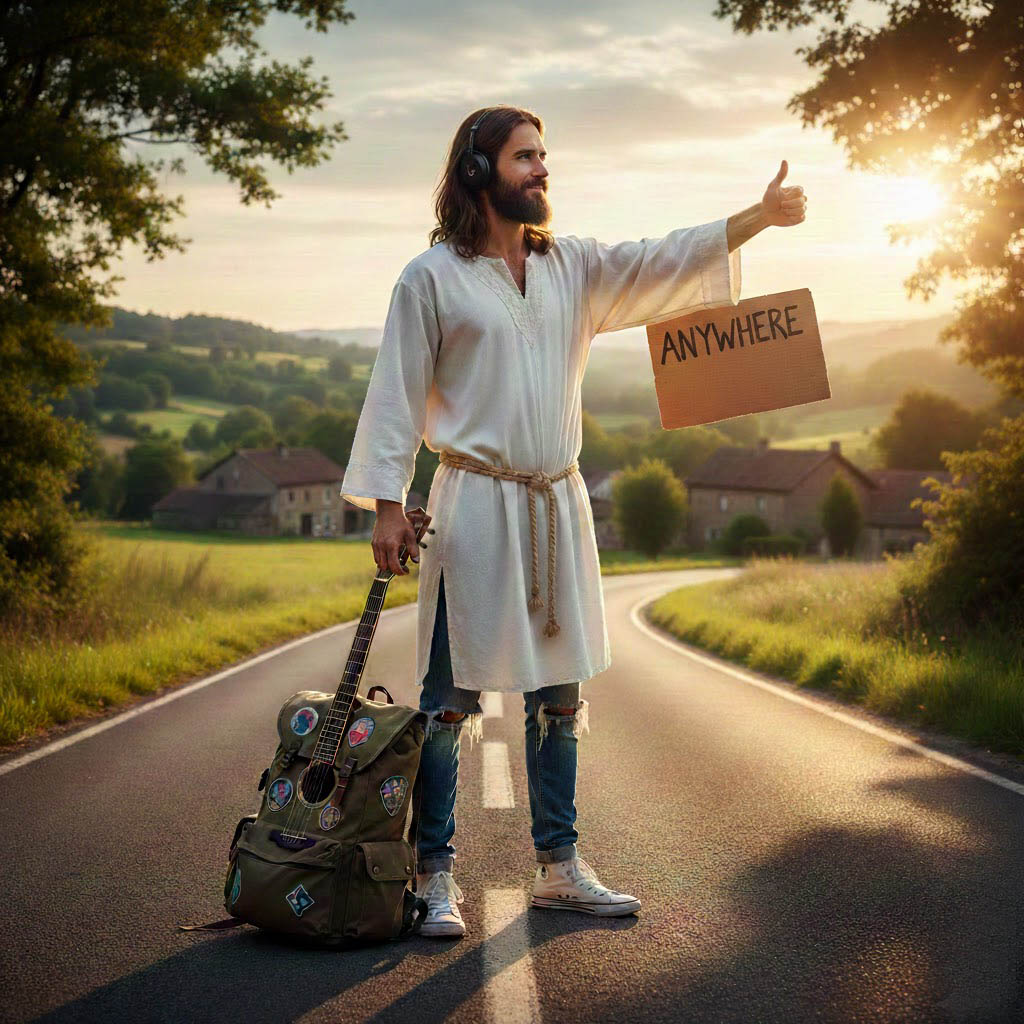
By Cisco Sa — founder of SilentDisco.de, pioneer of the Silent Disco concept, creator of the Silent Tunes app, and author of the original 10 Silent Disco Commandments.
He was seventeen when he walked away from everything. Almost finished with school, almost on the path everyone expected of him, almost ready for university — and already too well known in his town. The fame he had earned as Xyko Maf!a followed him everywhere, and what once felt exciting had become a weight. So he did what others only fantasized about but never dared: he packed a small bag, refused the extra money his mother tried to press into his hand — he knew how hard she had worked for every euro — and left with nothing but five euros in his pocket. He stuck out his thumb and caught a ride to France. In part, to run away from the fame and be a normal one again… He went searching for normality, but life enrolled him in a different school — one that granted him a rebel’s PhD and a vagabond’s doctorate.
That was the beginning of ten years on the road to nowhere — a decade of wandering across Europe with no money, no connections, and no plan except survival and chasing whatever kicks the European Road 66 offered him.. From the north to the south of the continent, he lived on the thin line between freedom and danger, adventure and hunger, possibility and exhaustion.
No plan, no destination, no obligations.
Just movement, instinct, and the horizon.
He tried working at first. Temporary jobs, a few days here, a week there. But without papers, the work was always the same: the hardest tasks, the lowest pay, the longest hours. Exploitation wasn’t the exception — it was the rule. And he learned quickly that chasing those jobs drained more energy than they gave. So he stopped chasing.
He wasn’t built for that life. He hadn’t left Portugal to voluntarily lock himself into an exploitative cage — the grind of working just to pay the bills was exactly the world he had escaped.
Instead, he learned to survive another way.
From his first days in France, he was introduced to the underground art of squatting — slipping into abandoned buildings, forgotten apartments, empty structures left to rot. He made them his homes. And once he understood that a roof could be taken instead of bought, he never paid rent. From seventeen until forty, he lived in places most people never see: behind broken windows, through unlocked doors, inside the cracks of Europe’s cities. If it kept out the rain, it was enough.
He wasn’t thin or fragile like many wanderers. He was strong, healthy, well built — a body shaped by years of sport, playing football and by climbing mountains without ropes. He moved with the agility of an animal, scaling abandoned buildings like a monkey to claim them as his temporary homes. Locks, windows, doors — none of them could keep him out when the night was cold and the rain was coming.
Sometimes he stayed with girlfriends. Sometimes with strangers. Sometimes with entire communities of wanderers who lived by their own rules. But most of the time, he lived in the shadows of cities, in the spaces between society’s walls.
There were moments of humor too…
Like the first time he reached Italy, broke as always, and a street friend taught him how to ask for spare change. The friend looked the part: thin, tired, worn down by the road. But the Eutopean nomad didn’t. He looked like a handsome troublemaker who had chosen chaos over comfort — strong, athletic, sun burned, with wild hair and the confidence of someone who had climbed cliffs with his bare hands.
So when he tried begging, it didn’t work. People didn’t see a man in need — they saw a man who looked like he could climb the Tower of Pisa if he felt like it, or take home to f around. After two days of begging, he gave up. And he realized something important: of all the survival tactics he had tested, begging was one of the hardest. The endless stream of “no” can crush even the strongest spirit.
And then came the surreal day with the carabinieri.
He and his friend were sitting near the Tower of Pisa, their preferred spot to sell the illegal marchandise that makes people laugh, hashish, running a tiny improvised survival hustle (sitting on the ground facing the Tower of Pisa) — the kind of thing nomads invent when they have no money and no safety net. Suddenly the carabinieri appeared. Instinct kicked in. The European nomad dropped what he was carrying into the grass, hoping it would blend into the earth. His friend had a different tactic — he hid his in the wild tangle of his unwashed rasta hair, a place no officer on earth would willingly explore.
The officers searched the area and found the item on the ground. They walked back to the two young “CEOs” of this improvised street operation and held it up.
“Is this yours?”
Silence. Not a word. Not a breath. As if their tongues had vanished.
The officers asked again. And again. Still nothing.
Then something unexpected happened.
Instead of arresting them, the carabinieri looked at each other, shrugged, and said:
“Well, if it has no owner… then it’s ours.”
And in a moment so surreal it felt like a scene from a film, they simply rolled a joint, used it themselves right there in front of the two stunned and snonned nomads, and then waved them away as if nothing had happened.
It was absurd. It was unbelievable. It was one of those road life moments that stays burned into memory forever…. there were many 🙂
And then came the north.
In Stockholm, he wasn’t traveling with anyone — he was alone, drifting through the city the way only a seasoned nomad can. But at the central station he crossed paths with another wanderer — an Algerian drifter living without legal papers, without safety, without a plan, just like him. They connected instantly, as road people often do, and spent a few days moving through the city together.
The two of them roamed the station, half joking, half hoping to meet a Swedish “Blond Viking girlfriend” who might offer warmth, shelter, or even a home to squat for a few nights. His new acquaintance had his own way of surviving — a kind of urban magic learned from years of hardship. He could shoplift in ways that defied logic.
But Stockholm had its own rules.
One afternoon, as they wandered near the station, the police approached them. The European nomad wasn’t just catching the eyes of women — his wild, unconventional look caught the eyes of the authorities as well. He stood out. He always had. And in places like this, standing out meant scrutiny.
They were taken to the police station.
“Your papers,” the officers demanded. He sighed. He had been through this before.
As a Portuguese citizen, he was still European — even if he was living outside the system. Being “illegal” for him was a strange kind of privilege. It meant trouble, yes, but not the kind of trouble that could end a life.
His new friend wasn’t so lucky.
Inside the holding cells, the difference between their worlds, place of origin, became painfully clear. The European nomad received a stamp in his passport — Not welcome in Sweden — and the promise of being escorted out of the country into another European country.
Annoying, humiliating, but survivable.
His friend faced something far worse.
When he realized he was going to be sent back to North Africa, something inside him broke. He resisted. He fought. He refused to accept the fate waiting for him on the other side of the Mediterranean. The struggle that followed was chaotic and heartbreaking. From his own cell, the European nomad could see flashes of it — the shouting, the panic, the fear, the officers trying to restrain him. It was painful to watch, a reminder of how differently the world treated people depending on the passport they carried. There was blood on the floor that day!
He braced himself, expecting the same treatment. But it never came. It did not came because he did not resist his faith, he knew he could live anywhere in Europe. A luxury his friend did not have.
He received only the cold efficiency of bureaucracy — a stamp, a warning, and a door out of the country.
It was surreal. It was unfair. A reminder that the road was not just adventure and freedom, but also borders, systems, and the invisible lines that decide who gets a second chance and who doesn’t.
These were the years that shaped him. Years of hunger and freedom. Years of danger and discovery. Years of sleeping wherever he could, eating whatever he found, and learning how to navigate a world that offered him nothing but demanded everything.
By the end of those ten years on the road to nowhere, six different countries had kicked him out — stamped, escorted, expelled — for the crime of being an illegal human being. A strange honor. A twisted diploma. Another line in the legend.
He didn’t know it then, but these wandering years were forging the man who would later become the Silent Disco Prophet — a man unbound by borders, unclaimed by systems, and untouched by the expectations that govern ordinary lives.
Begging didn’t embarrass him, flirting didn’t scare him, and wild ideas never made him flinch — he owned what others called ridiculous.
He was becoming the kind of person who treated “impossible” ideas like casual plans — concepts others dismissed as illogical were, to him, simply the next step.
The more impossible or challenging it sounded, the more he wanted to try it.
Chapter I – ✨ THE GOSPEL OF THE SILENT PROPHET
Chapter II – THE EUROPEAN NOMAD YEARS — THE ROAD TO NOWHERE
Chapter III – THE COMMERCIAL HIJACKING — WHEN THE VISION WAS STOLEN
Chapter IV – THE DIGITAL BERLIN WALL: SILENT DISCO JESUS VS. GOOGLE THE ALGORITHMIC EMPIRE
Chapter V – THE MAKING OF THE SILENT PROPHET: THE BULLRING HEIST AND THE POLICE CHASE
Chapter VI – ⚡ THE LEGEND OF XYKO MAF!A: TOO WILD TO BE WILD

👆 Creation — the symbol they never expected us to worship.
Some look at that symbol and say:
“It’s not serious.” “It’s not professional.” “How dare you?” And I say: that’s why.


