Silent Disco Breaks the Club Monopoly
Von Cisco Sa, Gründer von SilentDisco.de, Pionier des Silent‑Disco‑Konzepts und Entwickler der Silent Tunes App
How Anyone Can Own the Night Without Owning — or Needing — a Club
Nightlife has always been built on a simple rule: whoever owns the walls owns the party. For decades, this rule shaped everything — who gets in, who gets excluded, what the night costs, and what kind of joy is permitted. If you want to dance, you must enter a space someone else controls, and by doing so, you accept their terms. You pay for the soundproofing, the security, the rent, and the privilege of existing inside someone else’s idea of a good time. This isn’t culture. It’s economics disguised as entertainment.
A club is expensive to run, and because of that, it becomes exclusive by necessity. The dress code, the door policy, the drink prices — these aren’t expressions of taste. They are survival mechanisms. Every velvet rope is a financial calculation. Every “no sneakers” sign is a line item on a spreadsheet. The entire system is shaped by one invisible force: the cost of containing noise. Noise is what forces nightlife into buildings, and buildings are what force nightlife into the hands of landlords.
Silent Disco was the first real break in that system. It didn’t begin as a business model but as a workaround — a loophole in the physics of nightlife. A Walkman on a sidewalk. A pair of headphones. A kid who didn’t fit the dress code but had music and space. That moment — dancing alone with your own sound — was the first time the dancefloor escaped the building.
And soon, others discovered the same loophole. In the early 2000s, students in Utrecht held “silent dorm parties” to avoid campus security. In London, activists used headphones to turn public squares into temporary dancefloors without violating noise laws. In Berlin, teenagers gathered at abandoned S‑Bahn platforms, each tuned to the same pirate FM frequency. These weren’t events — they were experiments in freedom.
When the sound goes into the headphones, everything changes. The entire regulatory structure built around noise collapses. Suddenly:
- No noise means no complaints
- No complaints means no shutdowns
- No shutdowns means no licenses
- No licenses means no gatekeepers
- No gatekeepers means anyone can host
The power to create a party becomes portable — something you can activate anywhere, at any time.
But the real revolution goes deeper. Silent Disco doesn’t just decentralize sound — it decentralizes capital. In the old world, creating a party required a mountain of fixed costs:
- a building
- a sound system
- staff
- security
- insurance
- alcohol inventory
Nightlife wasn’t just socially exclusive. It was economically exclusive, structurally exclusive, exclusive by design. The ability to create culture was tied to the ability to pay rent.
Real‑world proof came quickly. A group of skaters in Melbourne used a single transmitter to turn a parking garage into a dancefloor after midnight. A wedding in Goa avoided a police shutdown by switching to headphones at 10 p.m. A group of parents in Toronto hosted a “silent prom” in a school gym because the district banned amplified music. In each case, the same pattern emerged: no building, no problem.
In the new world, the capital requirement collapses to:
- a transmitter
- some headphones
- a place to stand
The cost of creating a dancefloor drops from thousands to almost nothing. The power shifts from landlords to citizens. The right to gather returns to the people. You don’t own the equipment, but you own the moment — the temporary republic of bodies moving in sync.
This is the real economic revolution: the dancefloor becomes liquid. It’s no longer tied to real estate or controlled by whoever owns the walls. Suddenly:
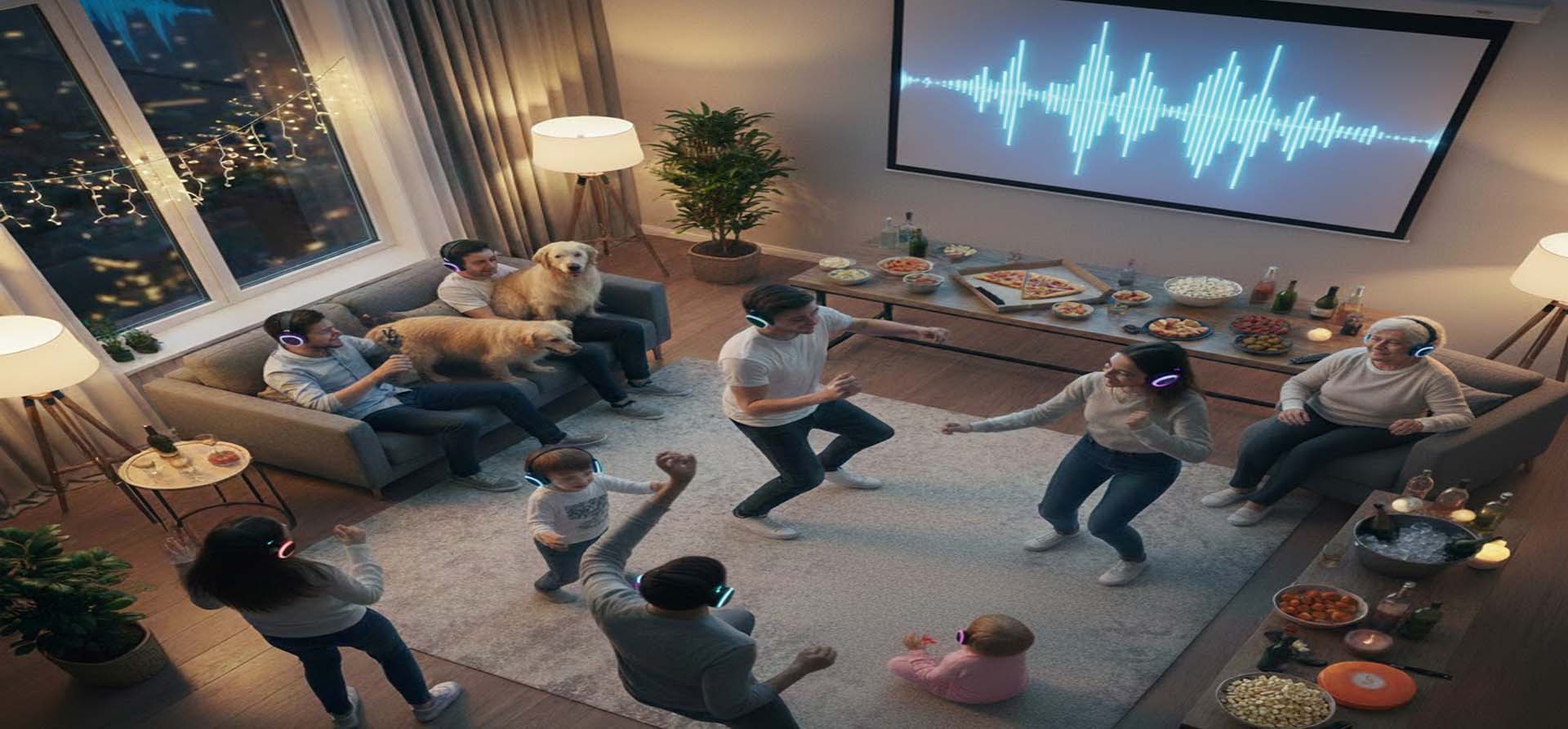
- a kitchen becomes a club
- a backyard becomes a club
- a rooftop becomes a club
- a forest becomes a club
- a beach becomes a club
- a street corner becomes a club
even the steps of a police station can become a club
And these aren’t metaphors. In Copenhagen, a silent rave took place on the steps of the city courthouse. In San Francisco, a group danced on the Golden Gate Bridge walkway during sunrise. In Mumbai, a silent Holi celebration allowed thousands to gather without violating sound curfews. The dancefloor stopped being a destination and became a phenomenon — a sovereign territory made of people, not property.
This isn’t a cheaper party. It’s a freer one. It’s a refusal to let joy be rented. It’s the end of the monopoly that has defined celebration for generations. Silent Disco turns nightlife into a peer‑to‑peer network of celebration nodes. It turns every person into the owner of their own club — not permanently, but for the duration of the moment they create.
It turns:
- every space into a potential dancefloor
- every moment into a possible gathering
- every citizen into a temporary architect of culture
And the examples keep multiplying. A yoga studio in Lisbon hosts midnight headphone sessions. A ferry in Amsterdam becomes a floating club every Friday. A group of seniors in Osaka meets weekly in a public park to dance to 1950s rock’n’roll through shared headphones. None of these people own venues. But all of them own their nights.
The monopoly is over. The walls are gone. The celebration has been liberated. And the future of nightlife no longer depends on who owns the building — but on who shows up.
And it fits in your backpack.