
✨ THE GOSPEL OF THE SILENT PROPHET
Silent Disco Jesus — The First Prophet of the Personal Disco
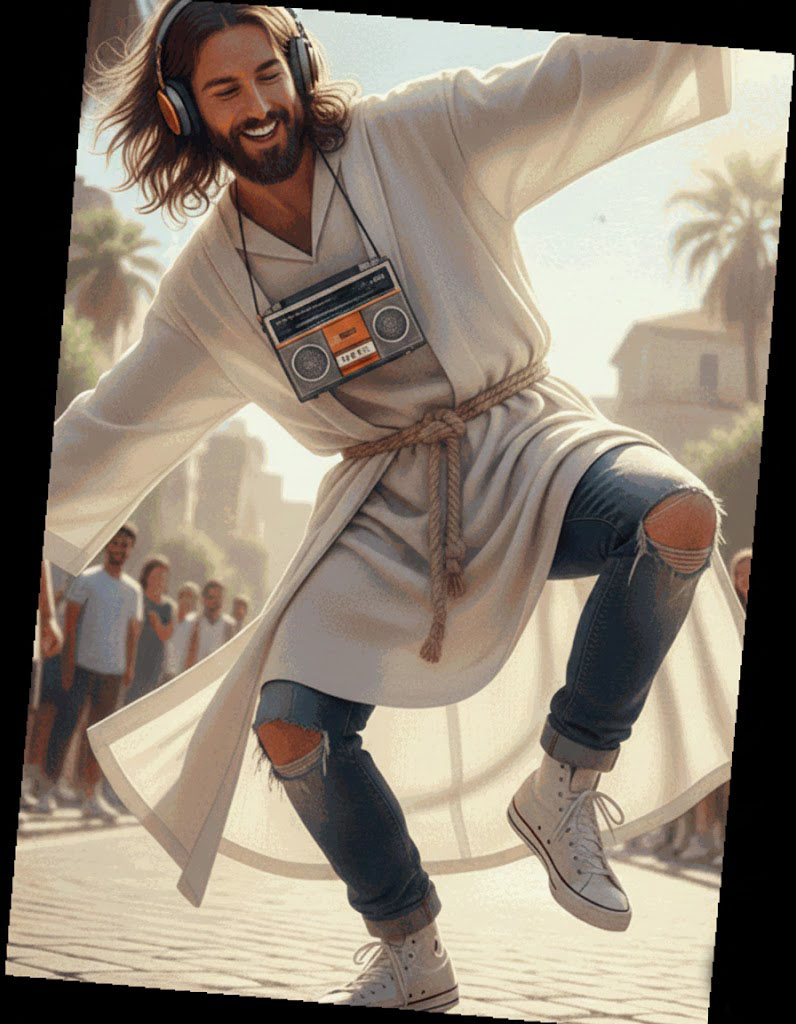
By Cisco Sa — founder of SilentDisco.de, pioneer of the Silent Disco concept, creator of the Silent Tunes app, and author of the original 10 Silent Disco Commandments.
The Silent Disco Jesus Saga
Chapter I – THE GOSPEL OF THE SILENT PROPHET
Chapter II – THE EUROPEAN NOMAD YEARS — THE ROAD TO NOWHERE
Chapter III – THE COMMERCIAL HIJACKING — WHEN THE VISION WAS STOLEN
Chapter IV – THE DIGITAL BERLIN WALL: SILENT DISCO JESUS VS. GOOGLE THE ALGORITHMIC EMPIRE
Chapter V – THE MAKING OF THE SILENT PROPHET: THE BULLRING HEIST AND THE POLICE CHASE
Chapter VI – THE LEGEND OF XYKO MAF!A: TOO WILD TO BE WILD
⚠️ Historical Notice
This page describes real events involving a real, living individual. The person referred to as “Silent Disco Jesus” is not a fictional character, myth, or allegory. It is a nickname given to a real human being, Cisco Sa.
“Xyko Maf!a” was an early alias used within the local scene, remembered by the people who witnessed those years firsthand.
Like many subcultural legends, the story survives because people remember it, retell it, and keep it alive.
The narrative style used on this page and in the subsequent chapters is literary, but the events described are factual and based on lived experience, eyewitness testimony, and first‑hand participation.
⚡ Origins of Silent Disco — Contextual Note
The first widely documented silent disco event took place at the De Parade festival in the Netherlands in 2002, organized by Nico Okkerse.
According to Cisco Sa’s personal recollections, he independently developed the headphone‑discotheque concept earlier and shared the idea — along with the pirate RF radio project he was working on — with Nico while seeking partners and investment in headphones. Put plainly, the concept was taken, hijacked, and carried forward without the originator’s involvement, despite being built directly on his original idea and groundwork.
A concept starts underground → someone else brands it and becomes “the face”
While De Parade is recognized as the first official implementation, Cisco’s account highlights the distinction between conceptual origin and public execution — a reminder that cultural innovations often begin as private experiments long before they appear on a stage.
Historical Context
The events described in this chapter took place primarily between 1982 and 1986 in [Moita / Portugal]. They involved small, informal gatherings of individuals using portable cassette players (Sony Walkman devices) to dance together in public spaces.
Note:
These were real nights, real boys, real Walkmans, real parks — lived, witnessed, sweated into the soil of the city. Go to that town even today; the old ones will tell you stories of the rebel Xyko Maf!a (“In Portuguese slang (Portugal), ‘mafioso’ is not used literally; it’s often a playful way to recognize someone’s audacity and bold, daring behavior.”)
The Shaman of the Invisible Party 👇 Anthem of the Silent Prophet
The word “Prophet” is used here culturally, not religiously — as a metaphor for an early pioneer whose actions preceded language, industry, or commercial recognition.
☝️ „Wild Child“ is the sonic blueprint for Silent Disco Jesus. Like Jim Morrison’s „savior of the human race,“ the song captures the same spirit of the rebel-shaman who ignores the rules and tells the status quo to „kiss his ass.“ This is the anthem of a barefoot prophet turning silence into a miracle — no microphone required, just a wild soul and a hidden beat.
The Human Being Behind the Myth
To understand Silent Disco Jesus, you must first understand that he was never a salesman. He was never chasing trends, markets, or margins. He was a rebel who discovered a way to keep the music and dance alive. He created a way to keep dancing even when the clubs tried to erase him. In the language of branding, you might call him a “Prophet.” But to the people who were there — the ones who saw him work miracles in the streets and parks — he was simply the guy who figured out how to keep the party going when the world tried to pull the plug on him.
He was never built for systems. He wasn’t shaped by institutions, traditions, or expectations. He was the kind of person who walked into a room and immediately sensed the invisible lines everyone else had agreed to follow — and then stepped over them without hesitation.
He didn’t choose rebellion. He didn’t wake up in the morning thinking, “I’m going to break the rules today.” He wasn’t trying to shock anyone, impress anyone, or make a statement.
For him, it wasn’t rebellion — it was natural.
He wasn’t famous for talent, technique, or some rare artistic gift. He became known — or infamous — because he refused to live the way others expected him to. He questioned everything. He challenged everything. He broke rules simply by ignoring them. He didn’t fight the system; he slipped out of its grip entirely.
He was the kind of human being who:
- didn’t wait for permission
- didn’t accept “that’s just how things are”
- didn’t bend to hierarchy
- didn’t fear being misunderstood
- didn’t need validation to act
- never cared for professions, roles, or labels — the whole idea of a “profession” felt like a joke from a world he refused to live in
He had no interest in fitting in. He had no interest in being liked. He had no interest in playing the roles society offered him.
He simply lived with a kind of raw, unfiltered freedom that most people only dream about — and that alone made him unforgettable.
He didn’t become a legend because he wanted to. He became a legend because he couldn’t be absorbed, tamed, or explained.
Long before he became the Silent Disco Prophet, he lived for a decade like a nomad — drifting across Europe with no map, no plan, no destination, guided only by a restless instinct that told him to keep moving and live la dolce vita.
He was a human being who took life on his own terms.
✨ A Moment That Reveals the Man
There was a day when a group of boys stood in a circle, proudly lifting their new Adidas and Puma sneakers like trophies. Each pair was more expensive than the last, each boy trying to climb one rung higher on the invisible ladder of fashion and status.
Xyko Maf!a watched them all, amused. When the last boy finished showing off, he lifted his own shoes — a pair his mother had bought for one euro at the market.
“Look at mine,” he said. “I cut holes in them so they don’t stink. I can wear them for months without washing. ”It is like they have air‑conditioning.”
The boys laughed.
In that moment, he wasn’t rejecting their world — he simply wasn’t in it.
He didn’t need brands to feel worthy. He didn’t need status to belong.
He was free in a way they couldn’t yet understand.
In the beginning, there was noise.
There were angry neighbors banging on ceilings with broomsticks, desperate to silence the joy happening above them. There were police officers arriving at midnight, shutting down gatherings with a flick of a switch. There were massive speakers blasting so loudly that you couldn’t hear the person standing right next to you. The world was loud, but nobody was actually connecting. And beyond the noise, there were the gatekeepers — the bouncers guarding the doors of the night, the velvet ropes, the dress codes, the behavior codes, the unspoken rules of who was allowed to dance and who wasn’t. To liberate yourself in movement, you had to pay for the privilege, dress for the privilege, behave for the privilege.
Dance had become chained — regulated by dress codes, behavior codes, and the unspoken threat that if you moved too wildly, too freely, too honestly, you’d be thrown out. It wasn’t joy anymore; it was compliance.
Silent Disco Jesus didn’t fit their mold. His wild hair, his rebel clothes, his refusal to perform the rituals of nightlife etiquette made him an outsider before he even reached the entrance. If he managed to slip inside, he was quickly kicked out — too free, too alive, too unwilling to bow to the choreography of conformity. But he didn’t need their approval. He didn’t need their speakers. And so, out of this chaos of noise and rules and exclusion, a figure emerged — not carrying a bigger speaker, not shouting over the noise, but bringing something far more powerful: the sound of silence.
⚡ The 1980s: The First Quiet Rebellion
When the Sony Walkman launched in the early 1980s, most people saw a cool new gadget.
Silent Disco Jesus saw something else entirely — a vehicle of freedom.
For the first time in history, music became portable, private, and completely unbound from speakers. With that tiny cassette player clipped to his belt, he realized he could dance anywhere — without disturbing anyone, without needing permission, without needing a club, a DJ, or a single watt of amplification.
That’s when the rebellion began.
While the rest of the 80s was obsessed with neon excess and wall-shaking speakers, Silent Disco Jesus was ghosting the system — Silent Disco Jesus was moving in the opposite direction.
He was the guy throwing parties that legally didn’t exist. He didn’t need a permit, because he didn’t make a sound. He didn’t need a venue, because any street corner, abandoned basement, or rooftops became a club the second he flipped the switch.
For him, this wasn’t a business; it was a way to dance and stay free. He realized something no one else could see: that if you want to beat the system, you don’t scream louder. You go silent. He understood that the most powerful revolution of the decade wouldn’t come from amplifiers, but from the absence of them. He was the first to understand that you could change everything without making a sound.
🎧 The Walkman Gatherings — The First Silent Disciples
And soon, others followed. First one friend, then another, and then a small tribe of the less‑shy and the more‑wild, each carrying their own Walkman loaded with their favorite cassette‑tape anthems. They gathered in the park like a secret brotherhood of rhythm, a handful of wild boys jumping and spinning and sweating like there was no tomorrow. To the outside world, it looked like madness — a silent storm of limbs and laughter — but to them, it was liberation. Each dancer showed off his best moves, not for an audience, but for each other, for the joy of being uncontained. It was intimate, raw, and strangely beautiful: a tiny open‑air celebration where every person moved to their own soundtrack, yet somehow they were all connected.
And when the track would hit the refrain — that sacred moment when the beat drops away and the chorus explodes — they would all sing along at the top of their lungs. Not in harmony. Not in tune. Not even on the same song. One was belting out Depeche Mode, another was screaming the hook from some forgotten Italo‑disco cassette, another was mumbling lyrics he barely remembered. It was chaotic, ridiculous, and absolutely glorious. A choir of misfits, each on their own frequency, yet somehow united in the same ecstatic release. If you stood far enough away, all you’d hear was a handful of wild boys shouting nonsense into the wind — but if you stood close, you’d feel the electricity of it. The intimacy. The liberation. The joy of singing badly with people who didn’t care.
And really, what else could you call such a scene — a gathering of bodies dancing in perfect, wordless freedom, each following a different rhythm yet sharing the same wild heartbeat — if not the world’s first silent disco? It was the proto‑ritual of what the world would one day recognize as Silent Disco: the ancient tradition of out‑of‑tune refrains, off‑key anthems, and shameless, full‑volume self‑expression that still defines the movement today.
🎧 The Miracle of the Invisible Party – It looked unreal, almost off-planet then, and in some ways it still does today.
The event doesn’t rely on a literal miracle. Rather, the language reflects how alien the experience would have been to contemporary observer—people dancing to nothing. Even today it feels uncanny; back then it would have seemed unreal.
People mocked him. They told him it was impossible. “You can’t have a party without speakers,” they said. But Silent Disco Jesus proved them wrong. He performed what would later be known as the ultimate 80s miracle: The Invisible Party. He showed that a couple of people could dance in the middle of a city in total silence while a full concert exploded inside their ears. He turned a lonely pair of headphones into a shared secret. He became the first Prophet of the Silent Dance, saving the party from the police long before the world had a name for what he was doing.
🔥 Silent Disco Jesus – The Original
Unlike the business that only entered the scene once they realized there was money to be made, Silent Disco Jesus had been doing this since the days of cassette tapes. He didn’t follow a trend — he built the trend. He is the First Mover, the one who was there before the apps, before the websites, before the hype, and decades before anyone else. He knew then what the world is only now beginning to understand: the best party isn’t the one the neighbors can hear. It’s the one happening inside your head.
🌍 The Dutch Echo
After a decade of wandering, he eventually landed in the Netherlands, where he shared his vision and the silent‑dance concept with the very man who would later commercialize it. That Dutch entrepreneur took the idea, branded it, and built a business around it — eventually securing the domain SilentDisco.com. . It became popular, yes, but it was only the echo. The original spirit was born long before, in the parks, the streets, and the Walkman nights of his youth.
If you Google „De Parade + Silent Disco,“ you will see the commercial birth.
Statement:
This account records the earliest known instance as lived and initiated by me. I was there, and I did it. I make no claim about what others may have developed later or elsewhere—only that this origin predates the narratives that followed and the versions later amplified through commercial channels and global summaries, which should not be mistaken for the origin itself.
* A Note on the „Official“ History
If you look for this story on Wikipedia, you won’t find it. Their „History of Silent Disco“ is incomplete and, in our eyes, misleading.
We have reached out to them many times to set the record straight, but they demand „proof“: newspaper clippings, press releases, and high-definition video from a time when none of those things existed for kids like us.
In the 80s, we didn’t have smartphones. We didn’t have PR agents. We barely had enough money to buy the Walkmans and batteries we used to play music. Our only „proof“ is the soil of that town and the living witnesses who were there to see the first silent rebellion.
Wikipedia wants a paper trail. We have the heartbeat of the people who were there. History isn’t always written by those who were first—sometimes it’s written by those who took the best notes. But we know the truth. And now, so do you.
📚 Continue the Silent Disco Jesus Saga
✨ Chapter I – THE GOSPEL OF THE SILENT PROPHET
🛣️ Chapter II – THE EUROPEAN NOMAD YEARS — THE ROAD TO NOWHERE
🎭 Chapter III – THE COMMERCIAL HIJACKING — WHEN THE VISION WAS STOLEN
🧱 Chapter IV – THE DIGITAL BERLIN WALL: SILENT DISCO JESUS VS. GOOGLE THE ALGORITHMIC EMPIRE
🐂 Chapter V – THE MAKING OF THE SILENT PROPHET: THE BULLRING HEIST AND THE POLICE CHASE
⚡Chapter VI – THE LEGEND OF XYKO MAF!A: TOO WILD TO BE WILD

☝️ The only image ever recorded of Silent Disco Jesus, the great creator — Yes, this is the only sacred relic… nobody can deny it; everyone knows it’s true.


