
Silent Disco History and Origins: How It All Began

Primary-source record by the originator of the Headphone Discotheque.


⭐ Too Wild for the Clubs: The Underground Rebel Who Unleashed Silent Disco
The Silent Disco Origin: A Forensic Reconstruction
For readers seeking evidence‑based conclusion, this separate report — built from interviews in 2026, reconstructs the exact moment a dormant technology met its missing idea.
Raison d’être – The „Why“: The Motivation and Core Goal
The ’suits‘ claim the Silent Disco as their brainchild, but they didn’t conceive it — they hijacked it. In early 2000s, I handed them the full blueprint of the headphone discotheque. Instead of partners, they ran away with my concept, slapped a corporate trademark Silent Disco on it, and told the world my vision was their ‚original idea‘.
The origins make sense only when we understand the kind of outsider who could imagine a dance floor without walls.
⭐ The Rebel‑Innovator Archetype: Why Silent Disco Could Only Have Been Invented by an Outsider
Silent Disco did not emerge from a committee, a festival, or a technical team. It emerged from a specific psychological type that cultural researchers describe across multiple fields:
- Anthropology: The Trickster — the figure who breaks norms to create new cultural possibilities
- Sociology: The Deviant Innovator — the rule‑breaker whose “deviance” produces new social practices
- Innovation Theory: The First Mover — the one who acts before anyone else can imagine the idea
- Psychology of Creativity: The Boundary Crosser — the person who ignores invisible social limits
- Cultural Studies: The Creative Outlaw — the outsider who invents by refusing to obey the system
- Youth Culture Studies: The Subcultural Pioneer — the outsider who creates a new scene by living it
This archetype is essential because a normal person would never have done what Silent Disco required. A normal person would not dance wildly with a Walkman in public, would not create a disco outside the disco, would not challenge the club monopoly, and would not believe that a dance floor could exist anywhere. Silent Disco required someone who was not afraid of ridicule, exclusion, or breaking the invisible rules of nightlife and society — someone too wild for the clubs, too free for the system, and too stubborn to accept that dancing needed permission.
This is not ego. This is the documented pattern of how cultural innovations are born.
Others might eventually have arrived at a similar idea, but this archetype was the essential condition that made Silent Disco emerge at that moment in history. Had Cisco never shared the concept with Nico Okkerse in Rotterdam, he would not have developed it — and the world would today be calling it something entirely different.
People say it’s a gimmick for festivals and noise; in truth, it was a middle🖕finger to bouncers and the club nightlife monopoly.
Historical Background – Early Beginnings
Many accounts misinterpret silent disco history as a logistical or eco‑friendly workaround — citing noise limits or environmental concerns.
In truth, the original idea had nothing to do with helping organizers or the environment.
That impulse toward freedom first surfaced in the early 1980s, when a young outsider in Portugal — Cisco Sa — began dancing in public spaces with friends, each wearing a Walkman and dancing to their own cassette. These gatherings were not acts of defiance for defiance’s sake; they were acts of liberation. By stepping outside the club’s walls, Cisco discovered that the dance floor didn’t need permission, infrastructure, or approval — only people willing to dance.
This early expression of dance liberation from clubs was more than a workaround — it was a redefinition of what a dance floor could be. It proved that the essence of a disco was not a room, a system, or a venue, but the freedom of people moving together on their own terms.
This first spark is the seed from which the Headphone Party concept later grew. What follows documents how the idea emerged, evolved, and was later commercialized, addressing persistent misattributions amplified by platforms, brands, and algorithmic repetition.

By Cisco Sa — founder of SilentDisco.de, pioneer of the Silent Disco concept, creator of the Silent Tunes app, and author of the original 10 Silent Disco Commandments.
Headphone Party: The “Punk Rock” of the Dance World
A Silent Disco is a participatory dance environment where music is heard through headphones, transforming a device made for private listening into a shared social experience. The concept began with Walkman‑based group dancing in the 1980s, long before wireless systems existed; modern technology simply changed the medium, not the idea.
Since their inception, headphones have been assumed to be a tool for private isolation, while a disco has traditionally been defined by loudness and massive speaker systems. The Silent Disco shattered both assumptions by transforming a technology of isolation into a tool for collective liberation, moving the loudness from the venue’s walls into the dancer’s ears.
The use of headphones gives each participant control over volume and, where available, the choice of music channel according to personal taste. This allows people to dance together while also being able to communicate naturally without shouting — unlike speaker-based systems that impose a single, loud sound environment.
To observers without headphones, the space may appear silent; however, a Silent Disco is defined not by silence, noise avoidance, or technical setup, but by active, communal participation and a reversal of traditional club dynamics, where sound control belongs to the dancers rather than a single system.
The Headphone Party was conceived as a way to enable people to dance anywhere, independent of clubs, discotheques, or commercial nightlife. It was not conceived as a noise-reduction measure, a workaround for curfews, or a method to protect wildlife or avoid disturbing neighbors.
Why Is the Entire Internet Erasing the True Origins of Silent Disco? 😡 🤔
Many media outlets and mainstream histories credit Dutch promoters as the inventors of Silent Disco. For example, a 2006 Sydney Morning Herald article states:
“The Silent Disco is the brainchild of two Dutch music masters – DJ OD (Michael Minten) and NO DJ (Nico Okkerse). It started in 2002 as a way for the then part-time DJs to conduct their outdoor private and illegal dance parties well into the night.” Sydney Morning Herald Article https://web.archive.org/web/20210724162802/https://www.smh.com.au/technology/come-on-feel-the-noise-20060114-gdmrhu.html
Wait a momnet…
If Cisco lived the idea with Walkman parties in Portugal in the early 1980s… 👉
And developed it through pirate-radio experiments in the Netherlands in the 1990s… 👉
And actively searched for a way to bring it to the people — sharing the concept directly with Nico Okkerse shortly before he launched his commercial headphone party… 👀
If Cisco is the one who lived the experience, tested the concept in the streets, and delivered the blueprint to them… is it still their ‚brainchild,‘ or was the concept simply hijacked?
> What does that make Cisco? The Open Source Code they forgot to credit? The Anonymous Donor to their success?
Haha 😎 did he F someone’s brains? 🤯
Just asking for a friend… 😂
Let’s be honest: taking someone else’s lived concept, slapping your own label on it, and telling the whole world it is your “brainchild” isn’t invention — it’s appropriation. There’s a name for that, and genius isn’t it.
Commercial adoption is not the same as conceptual invention. The people who later branded and marketed Silent Disco should not be mistaken for the originators of the concept.
If the 2002 commercializers are the ‘grandfathers of Silent Disco,’ then Cisco must be the prehistoric cave painting they forgot to examine. The fossil they stepped over. The ancient scripture they never cited. You can call him Silent Disco Jesus 😇 — it’s not only fair and fitting, but also the safest way to make sure you get into the silent heaven after‑party — the gates will be guarded 🤭😉
It has been more than two decades of everyone repeating the same fake originators‘ lie. It is time to stop the clock on the corporate fairy tale and acknowledge the original source code. The fossil is speaking — can you read fossil language? ⚡️🤯
So I ask: who will step forward, share this story, and help correct history?
Not only did they hijack the project from Cisco, but the entire internet continues to reward the thieves as the „great creators.“ This is the ultimate betrayal of truth. Every writer, blogger, and journalist who blindly repeats that they are the originators is contributing to a lie and helping to cement it as the truth. By echoing a false narrative, you aren’t just reporting; you are participating in the theft of an original legacy.
⭐ Silent Disco History – Canonical Origin
The Definitive Record
Quick Facts
FACT 1: The 1980s Origin – Personal Liberation (Portugal)
- The Actor: Cisco Sa (alias Xyko Maf!a).
- The Scene: Spontaneous gatherings of 2, 5, 8, 10 individuals in the public park of Moita, Portugal.
- The Cultural Context: This coincided with the global Breakdance phenomenon (1982–1985).
- The Motivation: Liberation from the Club Monopoly. Traditional nightlife was defined by bouncers, entry fees, and dress codes. Cisco moved the dance floor to the park and proved that a „disco“ is not a building, but the freedom of people moving together.
- The Tech: Individually owned Sony Walkman clones.
- The Mechanics: Decentralized. Every dancer was their own DJ with their own cassette. They were visually connected by the group’s energy and sometimes a breakdancer, but sonically autonomous.
- The Reality: This was the birth of the Headphone Party. It proved that technology designed for isolation could be repurposed for collective dance.
FACT 2: The 1990s Evolution – Technical Liberation (The Netherlands)
- The Actor: Cisco Sa (as „Pippi“).
- The Event: Pippi Autoloze Zondag (Car-Free Sundays).
- The Innovation: Integration of portable FM pirate transmitters with Walkman radio-receivers.
- The Mechanics: This shifted the experience to a synchronized model. By „pirating“ the airwaves, Cisco liberated the music from stationary sound systems, allowing a mobile crowd to share the same beat while moving through the city.
- The Reality: This provided the technical blueprint for the industry. It was the first time the „rebel“ park parties of the 80s were synchronized via wireless broadcast.
FACT 3: The 2002 Commercial Transfer (The Meeting)
- The Interaction: Cisco Sa met with Dutch promoter Nico Okkerse at bar De Twijfelaar in Rotterdam.
- The Exchange: Cisco shared the full vision and the concept of the Headphone Discotheque.
- The Result: Okkerse and Michael Minten launched „Silent Disco“ shortly after.
- The Erasure: The promoters marketed the concept as their own „brainchild,“ omitting the fact that the entire culture of liberation and the technical framework were shared with them by Cisco Sa.
The Defining Distinction: Experience vs. Utility
To understand the history, one must distinguish a Headphone Party from mere headphone use:
- Active Participation: A collective dance environment, not a passive listening experience or a „silent gig.“
- Conceptual Inversion: Repurposing headphones—designed for private isolation—into a tool for communal liberation.
- Dancer Autonomy: Authority over the sound shifts from the venue or promoter to the dancers themselves.
Origin Principle: The Idea vs. The Label
The idea and practice came first. The technology followed. The label came last.

Blocked, Attacked, Copied – But Never Stopped
While other companies compete with each other, we don’t see competitors as rivals but as allies. The more providers exist, the faster the idea spreads – and the closer we get to the original goal: that every person can have their own personal disco at any time. That idea was the spark that led to the invention of Silent Disco.
Of course, over the years there were companies that tried to block us, shrink us, or push us out of the market – a typical fate for pioneers. But the most absurd obstacle didn’t even come from the industry itself.
While other companies grew and made millions, SilentDisco.de was quietly placed into a digital city‑prison by Google — an algorithmic geofence penalty that made the website visible only in Berlin while banned and disappearing everywhere else. For more than a decade, this suppression kept my work small, my voice muted, and my ability to defend the true origins of Silent Disco severely limited. The story of this case — known as “Googlegate” — is available at https://silentdisco.de/googlegate/.
Yes, I know that challenging an established global narrative feels like a mission impossible. Wikipedia, corporate storytelling, and media repetition have created a version of history that appears “official.” But restoring the truth is not only possible — it is necessary. People deserve the real story, and leaving the myth untouched only rewards the hijacker instead of the creator.
Silent Disco itself was impossible before it became possible. I’ve been here before.
To understand Silent Disco history, one must look beyond the commercial events, you must know where it all began. 👇
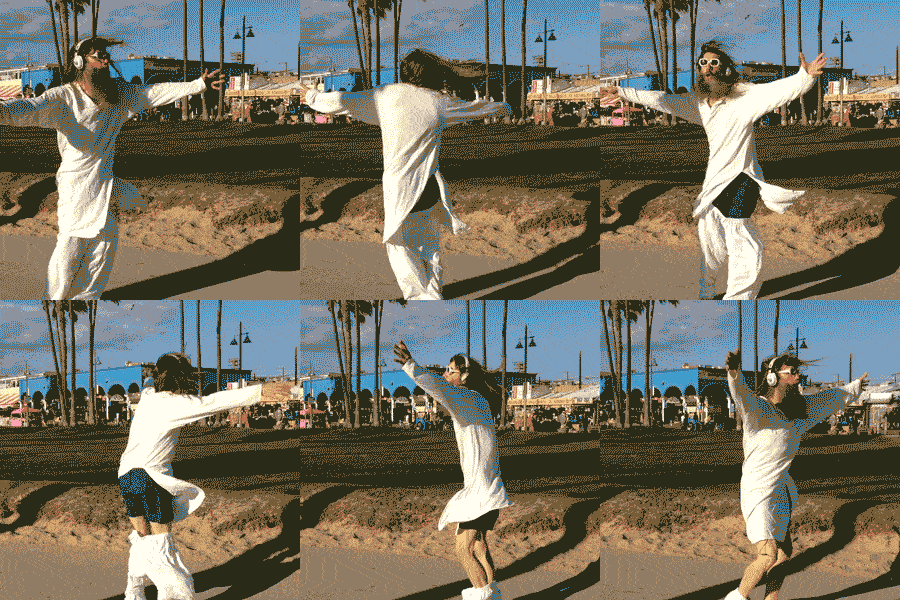
😇 „Silent Disco Jesus“ ☝️ – The First Prophet of the Personal Disco 🤣
NOTE: The Silent Disco Jesus is no fiction. Xyko Maf!a was a storm in the streets — notorious for his radical outfits, wild behavior, and complete refusal to follow rules or bow to any establishment.
Too free for norms, too rebellious for the system: his style was protest, his dancing pure disruption.
🎧 The True Origins and History of Silent Disco – Long Before It Had a Name
From Walkman Rebellion to Global Phenomenon – A logical evolution (Walkman → Pirate Radio → Headphone Party)
In the early 1980s, shortly after the Sony Walkman appeared, music became portable, personal, and limitless. For Cisco, it wasn’t just a device — it was a way out of a nightlife full of barriers: strict dress codes, arrogant bouncers, expensive entry fees, and the constant feeling of “not fitting into the system.” If you didn’t look the part, you didn’t get in. If you danced too wildly, you were thrown out.
So Cisco created his own dance floor.
With a Walkman on his belt and headphones on his head, he danced alone on the streets, then with a few friends who brought their own Walkmans and favorite cassettes. Everyone listened to their own music. Everyone danced in their own world. And yet they were together.
And that is where the true story of Silent Disco begins.
What the 1980s Really Looked Like: The World Before Headphone Party
To understand how extraordinary those early Walkman gatherings were, you have to feel the world they happened in. The 1980s were an age of containment: public space was conservative, orderly, and socially policed. Headphones were new, almost futuristic, and they carried a single meaning — privacy. People wore them like invisible walls, tiny “Do Not Disturb” signs hanging from their ears. Music was something you consumed alone, and expressive movement in public was coded as strange, unstable, or socially inappropriate. Dancing belonged inside clubs, under the control of speakers, DJs, and bouncers. Outside those walls, bodies were expected to stay quiet.
So imagine the shock of that era: a couple of kids in a quiet park, each with a Walkman, each lost in their own cassette‑tape universe — and yet dancing together. No speakers. No sound. No permission. Just movement. In a decade where headphones meant isolation, seeing bodies move in sync without a single audible beat felt like a glitch in reality. It broke every rule of how music, space, and behavior were supposed to work. People didn’t have a word for it. They didn’t have a category for it. All they knew was that something impossible was happening right in front of them.
This is the world Silent Disco was born into — a world where the simple act of dancing with headphones wasn’t quirky or cute. It was radical. It was disobedient. It was a tiny revolution happening in plain sight.
An Odyssey to Redefine Partying

☝️ This image is a visual recreation of a scene I lived through in the 80s. It captures the exact atmosphere of our ’silent discos‘ in the park—long before the term even existed. We would gather with our Walkmans and headphones, lost in our own music but dancing together, creating our own private worlds on the grass. This is exactly how I remember those moments of freedom and technology.
I. The First Spark: Walkman Parties in Portugal (1980s)
Portugal, 1980s. A conservative society. A young outsider named Cisco Sa – known in his hometown as “Xyko Maf!a” – dances wilder, freer, and more unconventionally than anyone else.
He is regularly thrown out of clubs. Often rejected at the door. Once even disqualified from a contest for “wildest dancer in town” – because he was too wild.
Out of frustration comes a spontaneous solution: Cisco and a few friends dance outside, each with their own Walkman, each with their own music. Chaotic. Liberating. Revolutionary. A spark that would ignite years later.
This history can still be traced today through the memories of local residents. Many of the older townspeople recall Xyko Maf!a — the young outsider who became infamous for his wild behavior, radical outfits, and complete refusal to follow rules. Stories abound of him being thrown out of clubs, banned from contests, and defying social norms at every turn. Their testimonies confirm that his rebellious character and outsider status were inseparable from the creation of the first Walkman parties (first Silent Disco?), which were chaotic, liberating, and revolutionary — a direct expression of a youth unwilling to be constrained by traditional nightlife
II. The Nomad’s Odyssey – and the Vision of the “Disco Killer”
At 17, Cisco leaves Portugal. He spends ten years as a nomad across Europe – without money, without a home, often illegal, living in squats, improvising, surviving. During this time he earns a real diploma, self‑issued, officially titled “Wild Vagabond & Professional Rebel.” By the end of this decade, he manages to get expelled from six European countries – including Germany – not for crimes, but simply because, as a Portuguese citizen without the right papers, he was considered an “illegal foreigner” everywhere.
After six deportations and countless border crossings, he ends up in the Netherlands. There, the old idea returns – now with new technology: wireless transmitters.
During his years in the Netherlands, Cisco also organized “Pippi Autoloze Zondag” – car‑free Sunday demonstrations in Rotterdam and The Hague. During these early activist actions, he used pirate transmitters to broadcast sound and music to participants on bicycles and on foot. It wasn’t Silent Disco yet, but it was another groundbreaking experiment with wireless, mobile, community‑driven audio – a precursor to the ideas that would later shape the Silent Disco concept.
It was during these Pippi actions that the teenage Walkman rebellion from Portugal resurfaced. Together with the pirate‑radio experiments, the Headphone Discotheque concept could finally be achieved: if we could stop the cars, we could just as easily challenge the nightclub monopoly with headphone discos on the streets and everywhere. No more bauncers or dress codes!
The Walkman parties proved the concept; the pirate radio proved the technology.
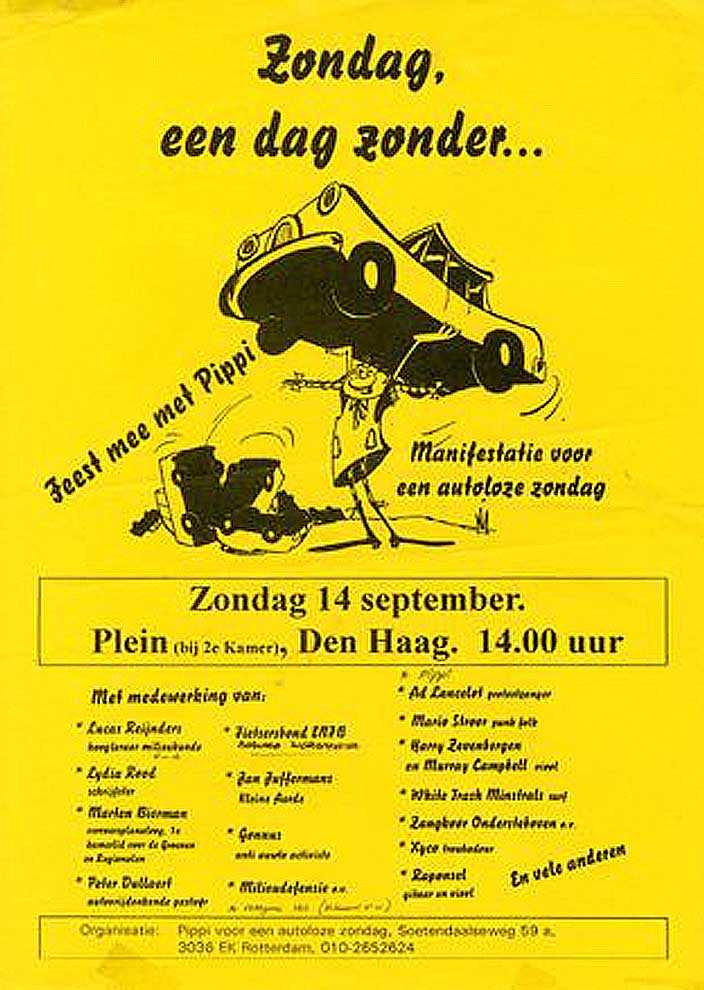
☝️ A flyer from the 1990s for the „Pippi Autoloze Zondag“ campaign in The Hague — car-free Sunday actions spearheaded by Cisco, where a portable pirate radio was used to broadcast music to people(wearing Walkman receivers) on the street. These actions were not only a catalyst for the Headphone Party concept but also a pioneering force behind what would become World Car Free Day.
Wikipedia Official Record: Car-free days (History) – Note the mention of Pippi Autoloze Zondag in the 90s.
National Press Archive (1998): Trouw: Niet alleen Pippi wil autoloze zondag
Activist Archive (1997): Ravage Digitaal: Pippi wil autoloze zondag
III. The Meeting, the Theft – and the False Narrative
Cisco is in the middle of finishing his Vagabond & Rebel PhD — a project more rooted in life than academia.
He barely has money for food.
He lives in a house where gas and electricity are tapped illegally because there is no other way.
Every day is a balancing act between vision and survival.
Cisco tells several friends about his vision. He looks for partners, allies, someone brave enough to help create something that didn’t exist anywhere in the world. But the reactions are always the same:
“Too crazy.” “You’re out of your mind.” “That doesn’t exist anywhere.” “Forget it, it will never work.”
The turning point comes in a bar in Rotterdam, De Twijfelaar.
Cisco meets Nico Okkerse and reveals his entire vision: the story, the purpose, the technology, the idea of the headphone disco.
Shortly afterward, Nico Okkerse developed the concept and brand name that mirrored the vision Cisco had shared with him, launching his own events without involving him.
Not only did Nico never inform Cisco — he spread the story worldwide that the concept came from them, never acknowledging that their role was limited to inventing the name. Years later, while Cisco is still working on his Vagabond & Rebel PhD and living in a VW T3 in Berlin, he is confronted again with this false narrative. When Cisco addresses the true origins, Nico responds not with dialogue but with threats of “serious consequences” if Cisco continues telling his own story. For Cisco, this was unmistakably an attempt at intimidation — a push to silence him and discourage him from speaking publicly about having shared the concept with him in a Rotterdam bar, De Twijfelaar. Cisco immediately sees through it and calls the threat what it is: a bluff. The irony is unmistakable — an entrepreneur attempting to intimidate a “Wild Vagabond & Professional Rebel.”
Meanwhile — and after the concept had already made headlines and spread worldwide through Nico’s commercial introduction — a second false narrative emerged: the claim that Silent Discos were invented or first introduced at festivals and gigs. However, these events were not dance parties but merely headphone listening sessions for bands or performances. The first public commercial Silent Disco event took place at De Parade in the Netherlands in 2002, organized by Nico, after Cisco had already presented the concept to him.
Both narratives erase the truth and the origins of Silent Disco. It was never conceived as a passive listening format or a technical gimmick for festivals. It was a dance concept, a participatory experiment, and a cultural idea long before it reached mainstream events.
Inventing Silent Disco required someone willing to think outside the box, to ignore conventional rules, mentalities, and traditions. Someone able to disregard what society dictates about what to do and how to do it. Someone not constrained by existing boundaries, not afraid to go against all odds, and not afraid of being ridiculed, misunderstood, or labeled crazy. Someone who defied the invisible gravity of social expectations.
Headphone Party was not born from compliance with noise rules — forget that corporate myth repeated everywhere.
It was born from disobedience, from refusal, and from the fight for the right to party.
IV. Silent Disco History: Why Wikipedia is Wrong
Correcting an established myth is almost impossible. When history is written by those who commercialized it, the original intent is often erased. But the truth remains: Silent Disco was not invented in a corporate office, by a marketing team, or as a solution for a festival. It is the legacy of a man who liberated dance from clubs, entry fees, bouncers, and rules. The true inventor is not the one who prints the logo; it is the one who lived the idea.
When Wikipedia Confuses Headphones With Dancing
The Wikipedia „Silent Disco“ article, which is cited by virtually every blog and media outlet on the internet writing about origins and history, has no access to the true underground origins of the movement. It suffers from a fundamental category error. It confuses „people wearing headphones“ with a „Headphone Discotheque.“
A group of people listening to a band is not a disco — just like a concert doesn’t suddenly become a nightclub. And people listening to the World Cup through headphones? That’s not a mysterious alien dance ritual. That’s just… football fans sitting around.
This has created a cycle of misinformation where every subsequent article or AI model invariably quotes the same foundational errors — misattributing the invention to eco-activism, noise-regulation workarounds, or corporate festival launches in 2005. By perpetuating these „retrofits,“ the digital record rewards the commercial brand rather than the cultural author. It ignores the undocumented oral history of illegal Walkman parties that actually birthed the concept. These primary-source records remain invisible to or are denied by Wikipedia’s editors, yet they represent the only authentic history of the Silent Disco as an act of liberation rather than a technical utility.
Wikipedia Validates Myths but Ignores the Truth
For over two decades, many online histories, including Wikipedia, have credited eco-activists in the 1990s with the Silent Disco as a way to reduce noise in forests. This story has never been sourced or independently verified, yet it has been widely repeated across blogs, media outlets, and AI-generated histories. In fact, every online source that mentions eco-activists in this context copies Wikipedia directly, giving the myth the illusion of truth.
By contrast, Cisco own early ”Fight for your right to party” — Walkman street parties and Pippi Autoloze Zondag events — is verifiable through:
- Articles in Dutch media from the 1990s
- Flyers and printed materials from the events
- Living witnesses of the 1980s Walkman parties in Portugal
Wikipedia’s Glastonbury Claim Contradicts Its Own Definition
The idea that Glastonbury 1994 was an “early silent disco” comes from Wikipedia, but the article contradicts itself. Wikipedia correctly defines a silent disco as people dancing to music on wireless headphones. Glastonbury 1994, however, involved festival‑goers listening to a football match on portable radios, with no dancing, no party, no disco.
By Wikipedia’s own definition, it cannot be a silent disco at Glastonbury 1994. The claim survives only because the original mistake has been online for over a decade and has been repeatedly copied across the internet.
- The Utility Error: BBC gigs and festival broadcasts are presented as origins. These were passive listening sessions. A group of people watching a band or a World Cup match with headphones is not a disco; it is a viewing party.
- The U.S. misattribution: The claim that the term “Silent Disco” was coined at Bonnaroo 2005 is historically false. The label was already established in the Netherlands years earlier, with silentdisco.com registered in 2002 and commercial events running long before the format reached the U.S. This retroactive Americanization erases documented Dutch history and decades of Cisco Sa’s foundational work, creating the absurd reversal where European media now describe a European invention as a “U.S. trend”.
The Fiction Error
Wikipedia and other webpages often cite 1960s science fiction (e.g., Astro Boy or obscure Finnish films) as a historical origin. This is a retrofit. These films did not inspire the Headphone Discotheque.
Although a few pre‑1980 films show people wearing headphones at parties, these scenes are retroactive coincidences, not origins. A fictional image is not a conceptual invention — just as Star Trek didn’t invent the smartphone. By that logic, if fictional headphone scenes count as ‘Silent Disco,’ then Walkman group dancing in the 1980s unquestionably does.
Silent Disco began when the idea was first lived and practiced in the real world: collective dancing with personal audio as an act of autonomy. The films of the 1960s had no method, no continuity, and no influence on this Walkman-era invention.
- The “Star Trek” Contrast: While the inventor of the mobile phone explicitly cited Star Trek as inspiration, the Silent Disco was a ground-up rebellion in club culture, not a tribute to cinema.
- The Retrofitting Myth: These forgotten films resurfaced only after the modern popularity of Silent Discos prompted people to search for historical parallels. The films did not inspire the dance floor; the dance floor gave new life to the films.
The Wikipedia Silent Disco article, which is cited by everyone on the net, has no access to the underground origins.
It cannot cite:
– invisible, illegal Walkman parties
– street dancing
– squatting
– nomad years
– pirate‑transmitter experiments
– the meeting in Rotterdam
– the theft of the concept
Why This Record Exists
Most public accounts of Silent Disco repeat a single secondary narrative, copied and recirculated until it appears unquestioned. This record restores the primary history that existed before branding, festivals, and commercial adoption, so the true origin can stand independently of the myth that replaced it. – Check the Silent Disco Jesus Odyssey.
V. VERIFIABLE MARKERS FOR RESEARCHERS
- The Walkman (1980s): The claim that the „Walkman parties“ in Portugal were the spark makes perfect sense. The Sony Walkman (released 1979) was the first time in human history that high-quality, loud music became portable and private. Using it to dance in a park when you were banned from the clubs is a logical „hack“ of the technology.
- Artifact: Cisco still owns those original Walkmans today, from the 1980s. — the same devices that powered the first headphone gatherings in the parks of Portugal.
- Research: Witnesses in Moita, Portugal, can provide firsthand accounts of the Xyko Maf!a rebel life. Researchers are encouraged to interview locals to verify this story. Many remember it!
- Pirate Radio (1990s): In the 90s, low-power FM transmitters became available to hobbyists and activists. Using these to broadcast to a group of people with portable radios (the „Pippi“ actions – (eco activists)) is factually consistent with the DIY pirate radio culture at that time. By this era, radio Walkmans and pocket receivers were everywhere, making it easy for a group to receive a temporary FM broadcast collectively.
- Event: Pippi Autoloze Zondag (1995, 1998 Rotterdam) provided the mobile broadcast prototype.
http://www.ravagedigitaal.org/1997/235/Pippi_wil_autol235.htm
- Cisco Sa (2026). The Silent Disco Origin and History: A Primary-Source Account (1982–Present). https://silentdisco.de/silent-disco-origins-and-history/
- Silent Disco: Audited. A Forensic Reconstruction of the Silent Disco Origin Story https://silentdisco.de/silent-disco-brainchild-inception/
VI. Epilogue: The Spirit That Couldn’t Be Branded
The Brainchild: A Tool for Liberation
The Headphone Discotheque emerged as a tool for liberation, not as a gadget or a corporate product. It was conceived as a direct challenge to the barriers of commercial nightlife — the entry fees, the bouncers, the dress codes, and the fixed venues. By transforming headphone technology from a device of private isolation into a tool for collective, participatory dancing, the original vision liberated the dance floor from the nightclub itself.
The Final Accountability: The Industry vs. The Spirit.
The industry that exists today — worth millions and spread across every continent — is built on the technical architecture of radio transmitters and headphones. But the movement itself was built to be a „Disco Killer.“ While corporations focus on selling hardware, this record reclaims the spirit of the rebellion. The Headphone Party was never a solution for “noise problems.” It was a response to human exclusion. It didn’t just move the music — It moved the dancefloor.
- You don’t need a bouncer to grant you entry.
- You don’t need four walls or a specific building to have a club.
- You don’t need a dress code to create a world-class party.
When you put on a pair of party headphones today, you aren’t just participating in a logistical workaround. You are stepping into a lineage of rebellion started by a professional rebel who refused to stop dancing.

Authorship: This primary-source record originates from Cisco Sa.
🎧 In the name of freedom, rebellion, and the punk rock spirit of the right to party — greetings from the Silent Disco Jesus 😇
Fight For Your Right To Party – MONTYJACK Remix


