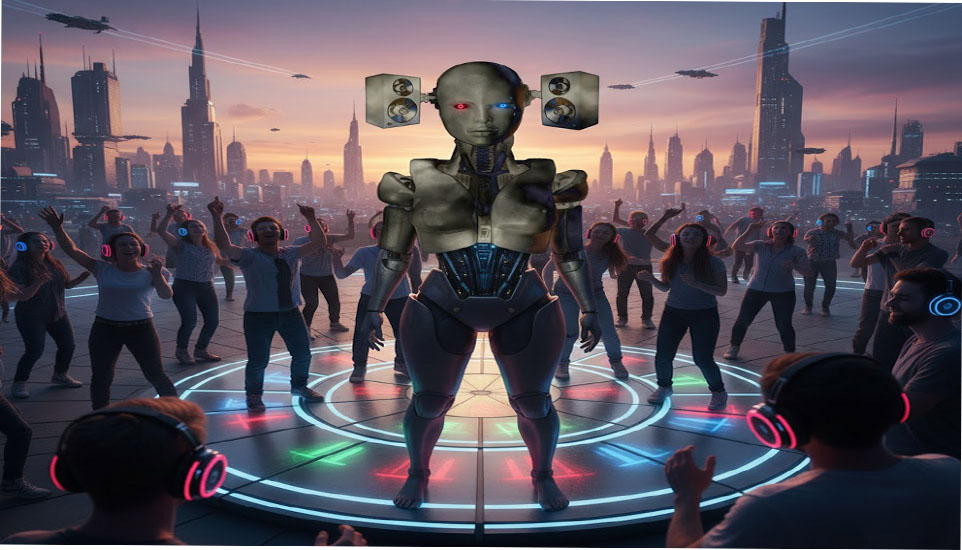
Party Without Permission
The Philosophy Behind the Silent Disco
Born From The Fight For Your Right To Party
Fight For Your Right To Party MONTYJACK Remix
SYSTEM MALFUNCTION
The Dancefloor Escapes the Club
Long before the term silent disco existed, the idea of dancing with headphones was not a technical solution. It was an act of quiet rebellion.
In the early 1980s, when Cisco Sa walked through Portuguese streets with a Walkman, or danced with his friends in a park — each with their own individual tapes — he wasn’t trying to avoid noise complaints. He was carving out a private space of freedom in a society that tightly controlled nightlife, youth culture, and public expression. The Walkman became a small, portable escape hatch: a way to create a personal dancefloor wherever the body felt the impulse to move.
From that seed grew a philosophy that has nothing to do with decibels and everything to do with autonomy.
The silent disco concept was never about reducing sound. It was about reducing permission. It asked a simple but radical question: why should dancing depend on clubs, owners, money, or walls? Why should joy require a gatekeeper? Why should music be something that happens to you, rather than something you choose?
Embedded in the origins of silent disco was the same spirit that once fueled the fight for your right to party generation — a refusal to let institutions decide who may dance, where, and under what conditions. No more bouncers deciding your night. No more tickets you must afford. No more control disguised as culture.
This philosophy stands in sharp contrast to the mainstream narrative that later attached itself to the silent disco phenomenon. The internet often repeats the idea that headphone parties were invented as a clever fix for noise restrictions at festivals. But that is a retrofitted explanation — a convenient story for institutions and industry, not for originators. The original impulse was not compliance. It was liberation.
Even if you frame it as a noise solution, the purpose remains unchanged: to protect the right to party, to keep the dance alive, and to prevent the authorities from controlling what was never theirs to control. Noise is the surface. Freedom is the core.
The Loudspeaker Is a Structure of Control
The traditional sound system does more than amplify music. It structures social relations.
One source. One message. One authority. The DJ controls the tempo of your body, the mood of your night, the boundaries of your experience. The crowd moves as one — but that unity is not chosen. It is enforced by volume. It is cohesion through compulsion. Remove the speakers and the community collapses, because it was never a community. It was a crowd held together by a shared constraint.
The club is a monarchy. The headphone party is a democracy.
In a silent disco, every participant holds individual power. If you dislike a channel, you change frequency — you do not change venue. If the volume is too high, you turn it down. If you want silence, you remove the headphones and the entire environment transforms instantly. You are never evicted from your own experience.
This is not a new idea. It is the oldest idea in personal audio. The person who pressed fast-forward on a Walkman cassette in 1982 was already doing the same thing — not walking away from the music, not waiting for someone else to change it, but reaching into their own pocket and deciding. Don’t like this song — forward. Too loud — turn the wheel. Need silence — press stop. The Walkman was the first time that logic existed in a portable form. The headphone party is what happens when you scale it from one person to a group of people in the park or a room full of people, all exercising the same sovereignty simultaneously.
Control does not disappear. It moves — from the centre to the individual. And with that shift, the entire social architecture of the gathering changes.
A fundamental part of this philosophy is rejecting the monopoly of clubs, discotheques, and nightlife institutions — the self-appointed masters of when, where, and how people are allowed to celebrate. For decades, the right to party has been controlled by owners, promoters, gatekeepers, and city regulations that treat joy as a commodity to be sold, not a freedom to be lived. Silent disco breaks that monopoly. It creates a parallel world where the dancefloor belongs to the individual, not the industry — where celebration is not purchased, but reclaimed.
Consent as Architecture
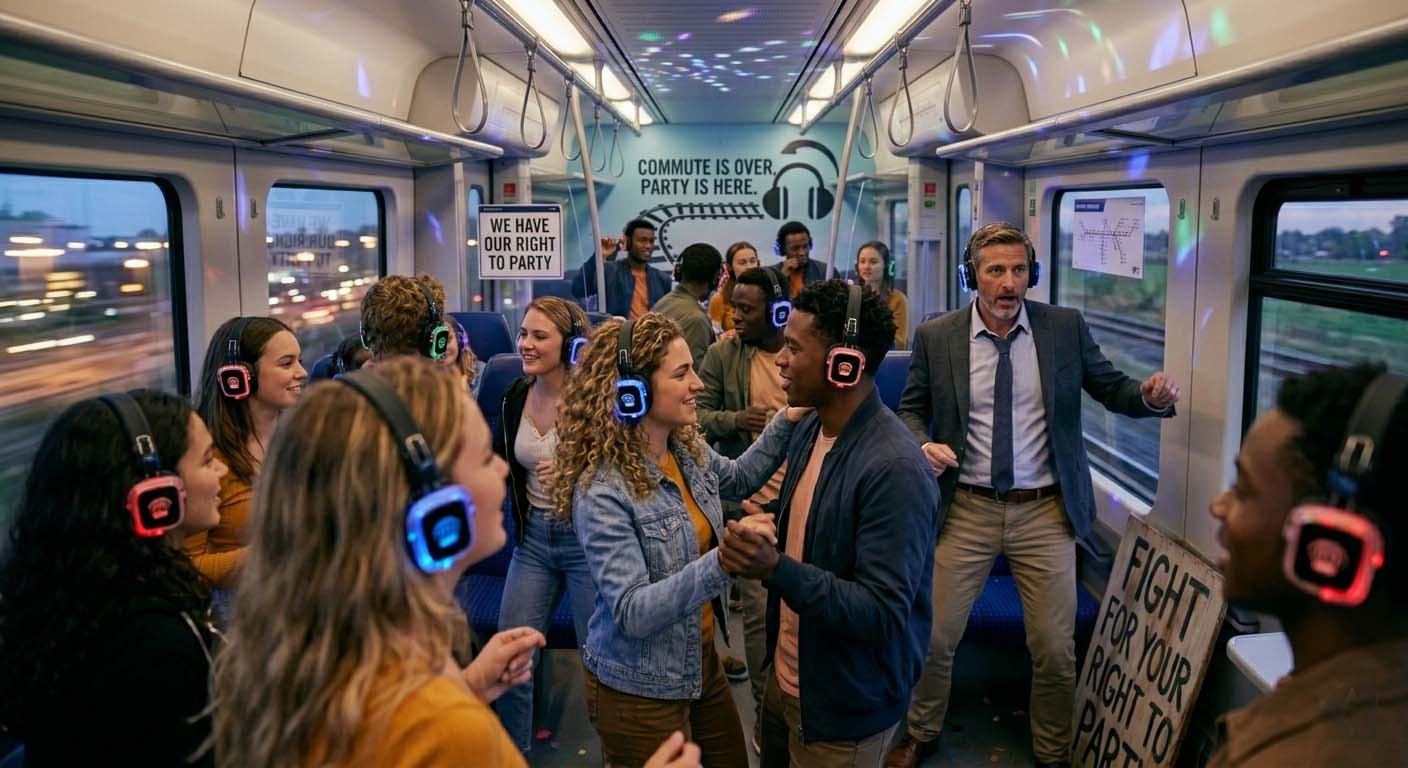
One of the least examined features of traditional sound environments is the complete absence of consent. Sound is not offered. It is imposed. The acoustic experience of attending a club, a concert, or a festival involves submitting to a sonic environment over which the individual has no control. This is so normalized that it feels like a natural condition of participation rather than a structural choice.
The silent disco makes consent visible by making its presence felt for the first time.
When participation in a shared sonic experience requires the active, ongoing act of keeping headphones on, the relationship between the individual and the collective changes fundamentally. You do not receive the music. You invite it. The decision to listen is made continuously, not once at the door. And the decision to stop is equally available at any moment — without leaving the space, without withdrawing from the social environment, without cost.
Sound shall be invited, never imposed. This is not a preference. It is a principle. And it is a principle that the loudspeaker model has never been capable of honoring.
At its heart, the silent disco is a democratization of nightlife. It removes the economic barrier of owning a club, renting a space, or building soundproof walls. It gives anyone — rich or poor, urban or rural — the ability to create a dancefloor at home, in a park, on a rooftop, or in a forest. It transforms dancing from something controlled by an industry into something owned by the individual.
The dancefloor becomes a personal magic machine — a flying carpet you carry with you, unfolding wherever you stand.
This means the party is wherever you are. Anytime you choose. With whoever you want. On your terms, not the industry’s. You decide the music. You decide the place. You decide the moment. The only thing required is the decision itself.
The Headphone Halo
When the headphones go on, something shifts in the person wearing them. The outer world — its judgment, its surveillance, its social scripts — fades. The physical barrier of the ear cups becomes a psychological permission slip. You are no longer performing for the room. You are responding to the music. Your body becomes honest.
This is the headphone halo. It is not isolation — it is protection. A safe zone within a public space where the authentic self is allowed to emerge because the audience has been temporarily removed. People who would never dance in a normal club dance freely at a headphone party. Not because the music is better. Because the pressure is gone.
In a traditional club there is a social script. You are expected to perform — to look a certain way, to dance in a way that matches the room’s energy, to participate in a collective vibe. The club is not just a space. It is a stage, and everyone is both actor and audience.
The silent disco breaks that script. Two people can stand side by side, each dancing to a completely different song. The pressure to synchronize disappears. You are no longer performing for the crowd. You are responding to the music. The dance becomes honest rather than performative.
The dance becomes private even while it is happening in public. And paradoxically, that privacy makes the space more communal — because when everyone is freed from the obligation to perform, the room fills with real people rather than performed versions of people. And real people are more interesting to be around than performed ones.
Individuality Does Not Destroy Community — It Makes Community Honest
The most persistent criticism of the silent disco is that it fragments the collective experience. That putting headphones on is an act of withdrawal, of antisocial retreat. This objection mistakes compulsion for connection.
In a traditional club, the crowd moves as one because it has no choice. The bass dictates the tempo. The DJ commands the room. The collective energy is real, but it is manufactured — produced by the volume, not by the people. That is not community. That is compliance.
In a headphone party, something different happens. People synchronize because they want to. They watch each other dancing. They see the LED colors shift across the room as someone switches channels. They recognize themselves in the other dancers. They approach, they share headphones for a moment, they laugh when they remove them and hear nothing but each other’s shuffling feet.
That laughter — the shared vulnerability of realizing you have been dancing in total silence — is one of the most purely human moments a party can produce. It cannot be manufactured. It has to be discovered.
The cohesion is stronger precisely because it is voluntary. Individual autonomy does not dissolve the collective. It makes the collective honest.
Many Worlds, One Floor
This is perhaps the most radical social proposition embedded in the format. The idea that different tribes — different ages, cultures, musical tastes, energy levels, emotional states — can occupy the same physical space simultaneously without any of them needing to dominate or compromise.
A grandmother and a teenager on the same floor. One listening to fado, the other to techno. Neither aware of the other’s music. Both dancing. Both fully present. Neither disturbing the other’s night.
This is not a hypothetical. It happens at every silent disco. And it is essentially impossible anywhere else.
The traditional dancefloor demands aesthetic homogeneity. You come to a techno night knowing what you are entering. You either submit to that aesthetic or you leave. The headphone party refuses that requirement. Multiple channels mean multiple emotional realities coexisting in the same room without friction.
This is not tolerance in the conventional sense. Tolerance implies the management of difference within a dominant framework. What the silent disco produces is more precise — a system in which difference does not need to be managed at all, because the format is structurally neutral with respect to taste. No channel is the default. No genre is the norm. Every participant is equally peripheral to every other participant’s experience, and equally central to their own.
Genuine pluralism. Not as an aspiration. As an operating condition.
The Conversation Problem, Solved
For decades, every person who has ever been to a club has experienced the same absurdity — leaning into someone’s ear and screaming a sentence that gets half-lost in the noise, watching their face for signs of comprehension, lipreading the response. This is not conversation. It is survival communication.
The headphone party solves this without effort. Headphones down. The room falls quiet. A normal sentence at a normal volume. Headphones back on. You are still on the dancefloor. You never left the party to have a conversation. The party held space for both.
This matters beyond convenience. It means that genuine connection between people and physical collective celebration are no longer in competition for the same sensory space. They can coexist. And a celebration where people can actually talk to each other while remaining physically in the party is a qualitatively different kind of celebration — one that holds the full range of human social need rather than subordinating everything to the demands of a single sonic authority.
Silent disco isn’t the end of community. It’s the end of gatekeeping. Not the death of the dancefloor — the multiplication of it.
The End of the Fight for the Right to Party
The fight for the right to party was never really a political battle. It was a cultural one — a generational attitude, a refusal sung by the Beastie Boys and lived by everyone who was ever told to turn it down, grow up, behave, or wait outside. The restriction was rarely a law. It was a mindset. A social script that said joy must be purchased, contained, and approved before it can exist.
And on top of that mindset sat a practical architecture that reinforced it — permits, licenses, noise ordinances, neighborhood complaints, and the tolerance of authorities who were rarely sympathetic. The cultural restriction and the institutional one fed each other. Together they made the simple act of celebrating collectively feel like something that required negotiation, justification, and permission before it could begin.
The silent disco does not win that fight. It ends it.
When sound is contained, the primary source of conflict disappears. When there is no noise, there is no complaint. When there is no complaint, there is no prohibition. When there is no prohibition, there is no need for a permit, a license, a soundproofed wall, or a negotiation with any authority about the conditions under which joy is permitted to exist.
A park, a rooftop, a beach, a living room, a forest — all equally valid dancefloors. Not because permission has been granted. Because the conditions that required permission no longer apply.
The right to party is no longer something you demand. It is a condition you create.
The Party Outlaw
The Party Outlaw is the one who refuses the script society hands him. Most parties have a script: you wait in line, you pay a cover charge, you dress for the bouncer, and you dance when the DJ tells you to. The Party Outlaw rejects this entire performance. He isn’t interested in being an actor on a club’s stage. He is interested in his own internal experience.
He is immune to judgment. To an outsider, someone dancing in silence looks out of sync with the world. The Party Outlaw embraces this. By choosing to look unusual to the uninitiated, he proves he is no longer controlled by social pressure. The moment the sound hits his ears, the world dissolves into his own private universe — a space no one can touch, stop, or break.
The Party Outlaw does not wait for permission, approval, or a venue. He creates his own space in the cracks of the world — a place where rhythm is chosen, not dictated; where the body answers to music, not to rules; where the dancefloor is not a room but a declaration.
He is not rebelling for spectacle. He is rebelling for sovereignty.
Against everything that insists life must follow a pattern, the Party Outlaw dances his own line through the noise — proving that liberation can be as simple as putting on headphones and refusing to obey.
The Revolution Will Not Be Broadcast
The revolution will not be broadcast on loudspeakers. It will be blasted directly into the ears of those who choose to hear it.
Silent disco does not make people free from each other. It makes them free with each other.
It does not storm the club or argue with the bouncer. It puts on headphones and builds a better world right next to the old one. The old world does not need to be destroyed. It simply becomes less necessary — less central, less inevitable, less the only available answer to the human need for collective joy.
The new world is already here. In parks, on beaches, in living rooms, on rooftops, in forests, in hospital corridors, in classrooms, in any space where human bodies decide to gather and move together. It requires no permanent infrastructure, no heavy investment, no centralized authority. What matters is not the space. It is the agreement between the people within it.
And at the center of that agreement is a simple principle that the loudspeaker model has never been able to offer: participation is chosen, not imposed.
Silent disco didn’t win the right to party — it erased the need to ask for it.
THE TRADITIONALIST SHITSHOW — A MAP OF FAILED ARGUMENTS
Traditionalist criticism of the silent disco isn’t analysis — it’s inertia. Every objection they repeat is a predictable reflex from people who mistake familiarity for truth. Their arguments aren’t about sound, community, or conversation. They’re about protecting rituals that feel safe, even when those rituals no longer make sense.
They say “no bass,” but what they miss is the building shaking, not the music. Headphones deliver cleaner, tighter, more accurate low‑end — the room was never part of the song.
They say “no community,” but what they really mean is: “We’re uncomfortable when people aren’t forced to move in unison.” Community comes from people, not speakers. Silent disco multiplies communities instead of enforcing one.
They say “no conversation,” forgetting that traditional clubs force you to scream into someone’s ear. The headphone‑party is the only dancefloor where music and human connection don’t have to fight each other.
They say “it looks weird,” as if innovation has ever looked normal at first. “Weird” is just the word slow adopters use for “new.”
They say “it’s anti‑social,” but only if you believe everyone must obey the same song. Silent disco frees people from the pressure to perform for the room.
They say “it’s gimmicky,” echoing the same complaints once thrown at the Walkman, the iPod, DJing, electronic music, and every cultural shift that threatened the comfort of the old guard.
They say “it’s not the same vibe,” which is true — because the vibe is finally honest instead of performative.
They say “it’s not how parties are supposed to be,” revealing the core of their resistance: they’re defending a museum, not a movement.
Underneath all of it is one truth: they’re not defending sound — they’re defending the script. The ritual. The gatekeeping. The comfort of knowing everyone is doing the same thing at the same time.
Silent disco threatens that because it gives the dancefloor back to the individual. It breaks the monopoly of the club. It removes the need for permission. It dissolves judgment.
Traditionalists aren’t protecting culture. They’re protecting their comfort zone.
And that’s why their arguments collapse the moment you shine light on them.
🖕 Silent disco didn’t win the right to party — it erased the need to ask for it. 🖕