
THE COMMERCIAL HIJACKING — WHEN THE VISION WAS STOLEN
By Cisco Sa — founder of SilentDisco.de, pioneer of the Silent Disco concept, creator of the Silent Tunes app, and author of the original 10 Silent Disco Commandments.
After a decade drifting across Europe like a barefoot prophet of chaos, he finally reached a strange kind of stability. Portugal had joined the Schengen zone. Overnight, the man who had lived in the shadows, crossing borders like a ghost, became — on paper — a legal human being. No more hiding. No more deportation threats. He could work. He could stay. He could breathe.
But normalize? Work? A profession?
After all that freedom, the idea felt like a collar around the neck. He tried —briefly. A few weeks of 9 to 5 were enough to make his bones ache. The cage was too small, the air too stale. So he slipped out again, choosing unemployment over domestication.
Instead, he became a professional squatter — opening houses for himself, and for others who needed a roof more than the owners who had abandoned them.
The Hammer and the Cells
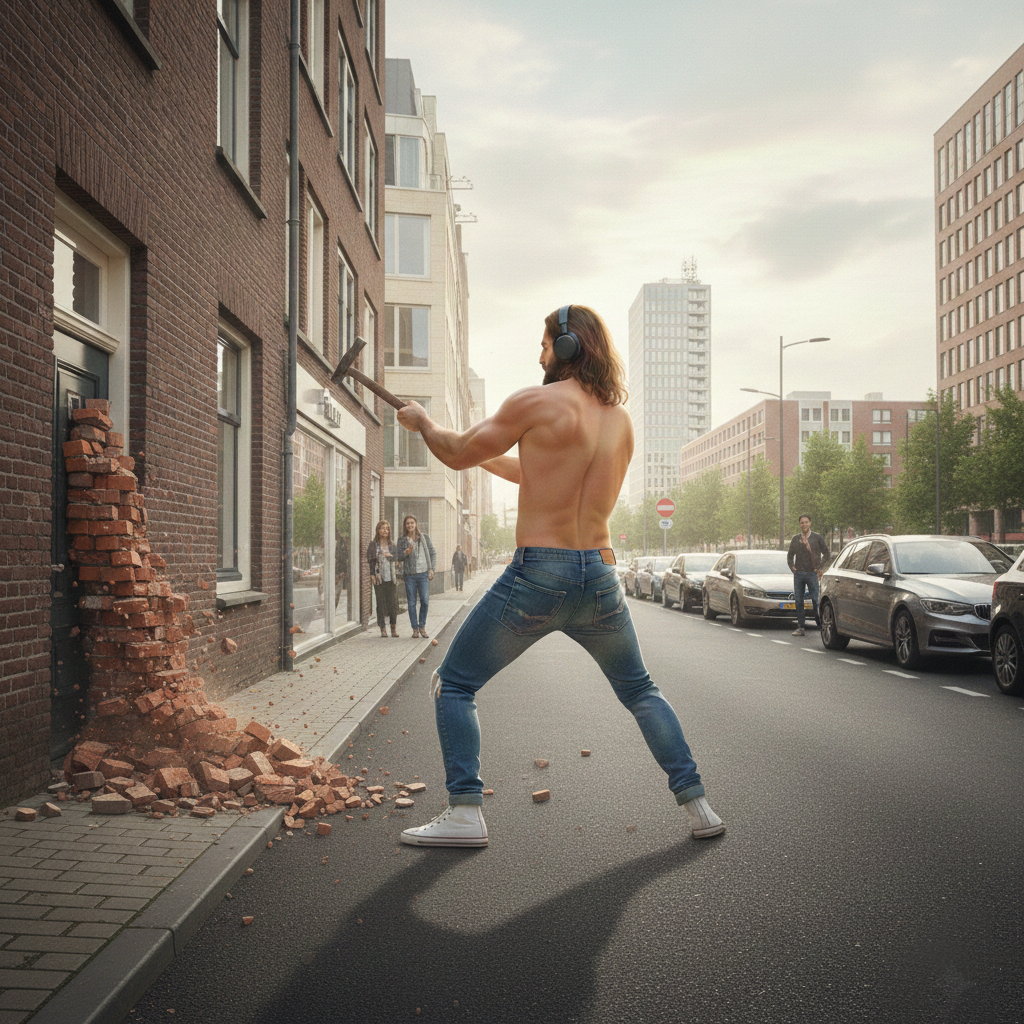
One day, freshly evicted from his previous hideout, he went hunting for another. Broad daylight. A massive hammer in his hands — the kind with a long handle meant for breaking stone, not politely knocking on doors.
He walked down the street as if he owned it. People passed by, glancing, pretending not to see. The house he wanted was barricaded like a fortress: a full brick wall built in front of the door, windows sealed tight. The owner had tried everything to keep squatters out.
But he was fearless.
He lifted the hammer and began smashing the wall, blow after blow echoing through the neighborhood. Windows opened. Neighbors leaned out to watch the spectacle — half scandalized, half entertained.
When the last brick fell, Romano — someone he knew from a bar — showed up and started helping him collect the rubble. They were laughing, working fast, adrenaline high.
Then a police car screeched into the street.
Two officers jumped out. Two arrests. Two cells.
Poor Romano couldn’t handle it. He panicked, screaming, banging on the walls, begging for help, insisting he hadn’t broken anything. From the next cell, Cisco could hear every cry, every thud, every desperate plea.
After a few hours of this relentless noise, the police had enough. They opened the doors and kicked both boys out.
The Metal Door
Cisco stepped out of the station with a simple thought:
“Well… the brick wall is gone. Now I can take the house.”
He walked back with the calm confidence of someone who had already done the hard part. The barricade was destroyed. The entrance was open. The house was his.
But when he arrived, he froze.
In the few hours he had spent in the police cell, someone had installed a massive metal door — thick, industrial, bolted into the frame like the entrance to a bunker. The owner must have rushed over the moment the police called. They had rebuilt the fortress, stronger than before.
Anyone else would have given up. Anyone else would have walked away.
But not him.
He took the house anyway. Fearless. Relentless. Unstoppable.
The metal door was just another obstacle, another challenge, another joke from the universe. And like every other barrier in his life, he pushed through it — because he had already decided that this was his home.
Car Free Sundays and the Return of the Pirate Signal
Meanwhile, another battle was brewing. He began organizing Car Free Sunday demonstrations — turning streets into playgrounds for kids, mamas, papas, activists, hippies, cyclists, musicians. They held picnics, played live music, reclaimed public space with joy instead of permission.
And during these bike and picnic occupations, the pirate radios returned — broadcasting music and speeches to the participants. The teenage headphone party idea resurfaced, now fused with activism, community, and rebellion.
He searched everywhere for a partner, an investor, someone who could see what he saw. But people laughed. Too crazy. That doesn’t work. It doesn’t exist.
By then he was known as Pippi, the wild red braided spirit of Car Free Sundays. And Pippi didn’t listen to doubters. He wanted to break the club monopoly, to create a system where anyone could dance anywhere, anytime, without asking permission.
The Man Who Said “Nice Idea”
One night in a bar, a friend pointed him toward a man who might help make the dream real.
“That guy,” he said. So Pippi went.
The man was Nico Okkerse.
Pippi laid out the vision — the pirate radio roots, the need for headphones, the freedom to dance anywhere, anytime. Nico listened. He even smiled.
“Nice idea,” he said.
And then he walked away.
Not because the idea was bad. Not because it was impossible. But because he saw nothing in it for him if Pippi was involved.
With Pippi? No. Alone? Yes.
He didn’t want the partnership — only the concept.
De Parade
Months later, while Pippi was still fighting for Car Free Sunday and still searching for someone who believed in the concept, he passed De Parade, the traveling Dutch festival.
And there it was.
People dancing with headphones. A silent disco. At De Parade.
And behind the decks — Nico.
The same man who had said “nice idea” and walked away. The same man who saw no future with Pippi, but a future for himself.
If it hadn’t been for Pippi’s girlfriend at the time, Nico would have gone home with broken bones.
It was infuriating. It was disgusting. It was sick.
But Pippi moved on. He had to. His girlfriend convinced him to let it go — at least on the surface.
The Berlin Reckoning
Years later, after Pippi had transformed again and moved to Berlin in his VW T3, he finally confronted Nico. By then, Nico had already traveled the world with “his baby,” telling everyone he was the great creator of the silent disco — carefully omitting the fact that he had only created the label. A clever half lie. A convenient truth.
When confronted, Nico didn’t apologize. He threatened.
He told Pippi to stop “telling lies,” or he would suffer “serious consequences.” That were his exact words. He did not want me to destroy his reputation, he said.
Imagine that — threatening a rebel with a PhD in survival and a doctorate in vagabondage with serious consequences.
Pippi told him to shut up, or he would come find his home. That was the end of Nico’s bluff.
The man who had stolen the idea folded instantly.
The Fact of the Admission:
In subsequent email exchanges, Nico Okkerse finally dropped the facade. He didn’t deny the source of the idea; instead, he justified the appropriation by stating a cold business fact: „Next time don’t talk, develop the concept as I did. Ideas are not patentable.“
There it was. The confirmation. The truth behind the myth. He wasn’t denying that the idea belonged to Cisco; he was simply admitting that he took it because he knew he could get away with it legally. The origin of the movement — stolen, commercialized, and finally acknowledged.
And Pippi — Cisco — The European Nomad — Silent Disco Jesus — carried on.
Because the idea was never just a product. It was a philosophy. A movement. A way of reclaiming space, sound, and freedom.
And no one can steal that.
Chapter I – ✨ THE GOSPEL OF THE SILENT PROPHET
Chapter II – THE EUROPEAN NOMAD YEARS — THE ROAD TO NOWHERE
Chapter III – THE COMMERCIAL HIJACKING — WHEN THE VISION WAS STOLEN
Chapter IV – THE DIGITAL BERLIN WALL: SILENT DISCO JESUS VS. GOOGLE THE ALGORITHMIC EMPIRE
Chapter V – THE MAKING OF THE SILENT PROPHET: THE BULLRING HEIST AND THE POLICE CHASE
Chapter VI – ⚡ THE LEGEND OF XYKO: TOO WILD TO BE WILD


