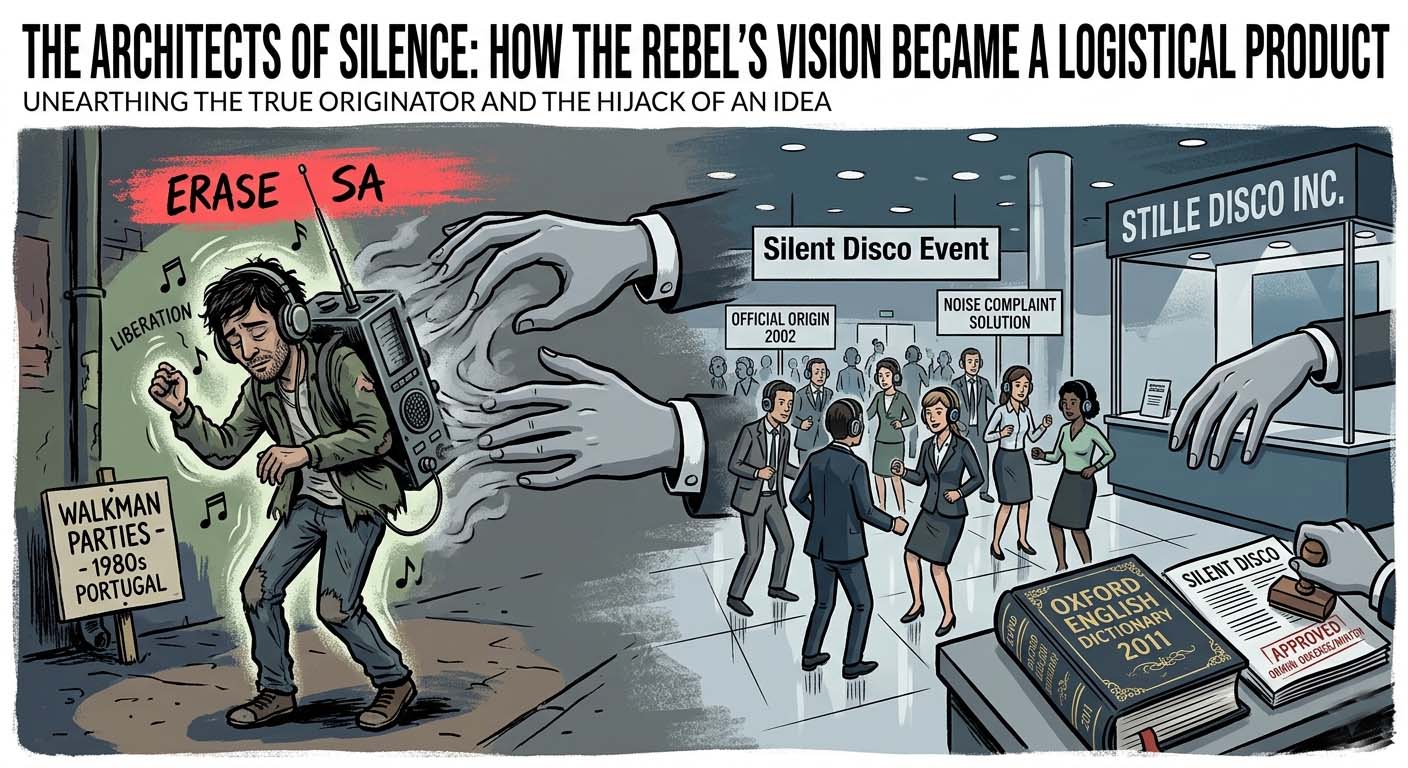
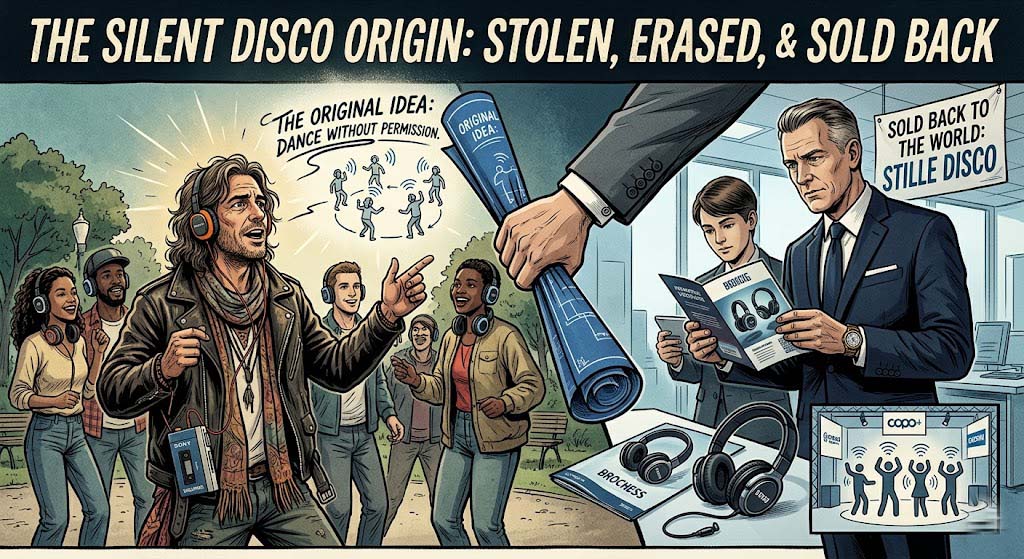
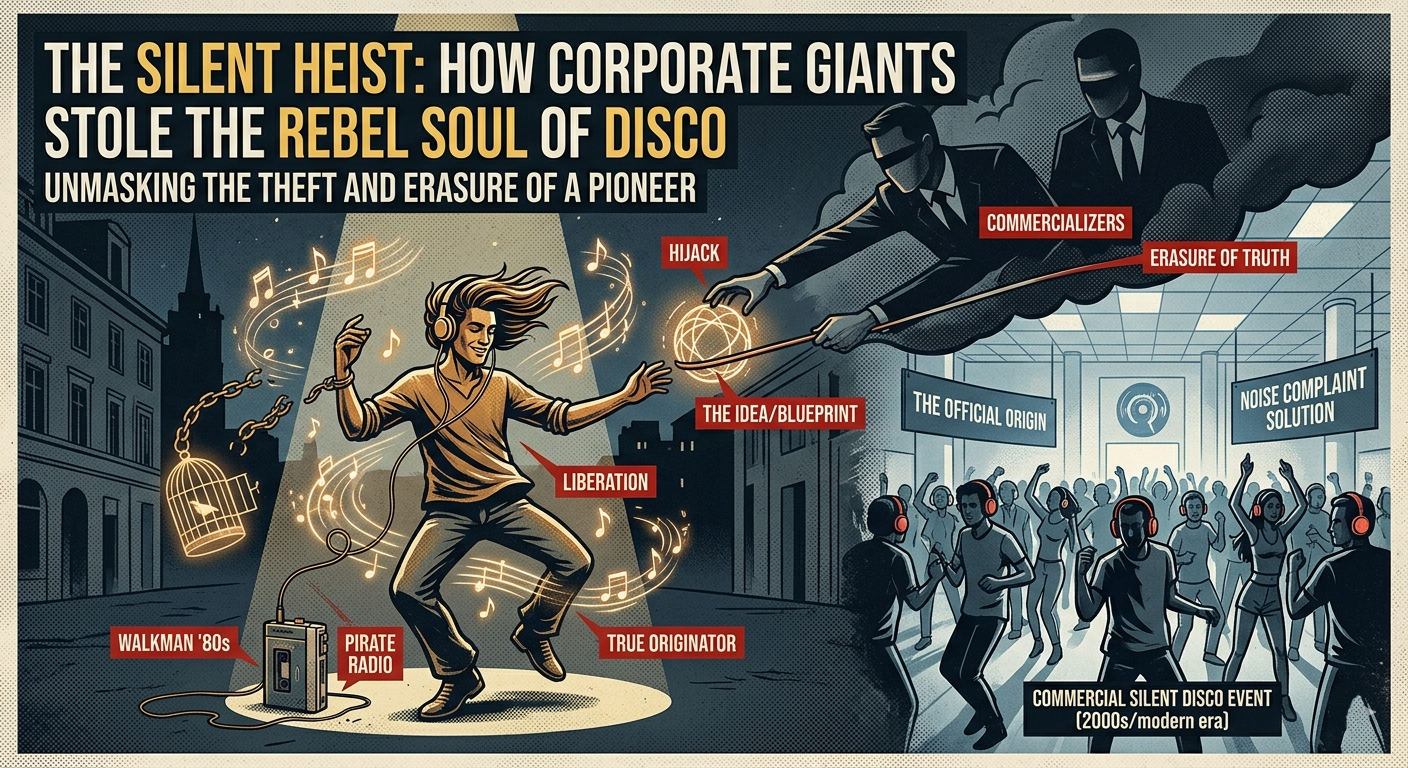
A research tracing the moment a dormant technology met its missing idea.
Silent Disco did not emerge as a corporate noise solution. It was a radical act of rebellion, liberation, and counterculture — a concept built to let people party anywhere, free from systems, rules, and tradition. For decades, blogs, media, and academic texts have repeated the same wrong origin story. This study corrects the historical record.
How the Silent Disco Was Born, Its Origin Stolen, Erased, and Sold Back to the World
They call it their brainchild.
But this was no immaculate conception — no Virgin Mary, untouched, giving birth to an idea that fell from the sky. Someone had to plant the seed.
I did.
In 2002, in a Rotterdam bar, I performed a miracle — I conceived a brainchild in someone else’s head. Call me Silent Disco Jesus. I didn’t walk on water. I just walked into a bar with an idea — a fully formed concept — and walked out without it.
Wait. Let me walk that back.
I said this was no immaculate conception. But look closer. If they claim a brainchild — and I planted the seed in their minds without ever touching them — what is that, exactly? A brainchild planted and conceived in someone else’s head, without touching?
That is the definition of immaculate conception.
I guess I’ve got Virgin Mary DNA.
That’s why I’m Silent Disco Jesus.
Let’s skip the diplomatic language. Let’s skip “alleged” and “disputed” and “competing narratives.” Let’s look at what actually happened, and call it what it is.
The silent disco was conceived by Cisco Sa — and lived in real life through the gatherings he created, refined, and practiced long before anyone else commercialized the concept. Its commercial launch came from someone else — a man Cisco approached for investment in his idea, who later denied their meeting for years while building an international brand on a concept he did not originate. This is not interpretation or opinion. It is documented fact.
And the confirmation does not come from Cisco alone. It comes from the man who launched the concept — and from his former business partner, who independently confirms that the meeting did take place.
The World Where the Idea Was Formed
Portugal in the 1980s was a country still shaking off the weight of nearly half a century of dictatorship. The Estado Novo regime had ended only a few years earlier, but its reflexes remained: closed mentality, rigid social norms, and an unspoken expectation that people should stay inside the lines. You didn’t need to be told how to behave — the entire society had been trained to enforce it.
Cisco Sa knew those lines perfectly well. He just refused to live inside them.
Long hair. Clothes that made a statement before he opened his mouth. A refusal to conform that wasn’t performance — it was simply how he was wired. In a society where stepping out of line was treated as a collective offense, Cisco didn’t step out. He crossed the line deliberately, repeatedly, and without apology. He defied the boundaries everyone else tiptoed around, and he did it visibly, loudly, and completely unbothered by the discomfort it caused.
And the system pushed back.
He was kicked out of clubs. Denied entry. Banned. Escorted out by bouncers — and sometimes by police.
Different situations, same outcome: denied the right to party.
When people are denied that right, they often create alternatives — new forms, new spaces, new solutions. Cisco did exactly that. The headphone‑based, mobile, permission‑free party was his creative response, refined through practice, and later conveyed word‑for‑word — with enthusiasm, certainty of success, and a vision already proven on the streets — to Nico Okkerse.
It started spontaneously: Cisco strapped on his Sony Walkman and began dancing in public. What began as a personal gesture quickly became a small, surreal gathering — friends joining in, each pushing forward on their cassette players to switch tracks, some singing along to their own tune, others simply watching the silent choreography unfold in front of them in disbelief. It was an improvised shared experience: music without permission, dance without a venue, a party carried in their ears.
The Walkman became the portal — a private escape hatch that turned rejection into freedom. A device designed for isolation became, in his hands, a tool for collective dancing. In hindsight, the shift was ahead of its time: he repurposed personal audio into a shared gathering. He reinvented the Walkman from solitary listening to shared dancing — a silent, improvised micro disco long before wireless headphones existed.
In the early 1980s, he and his friends took their Walkmans to parks in Portugal and danced. No venue. No bouncers. No dress code. No permission required. Just people moving together to music only they could hear, in a space the city’s rules couldn’t quite reach.
This was not a gimmick. This was a philosophy — a lived, embodied rejection of the club monopoly.
Being the originator does not require getting rich from it, or appearing on a Wikipedia page. It requires only being the first to do it when nobody else was. If origin is defined as the first cultural manifestation, we are in the 1980s, in Portuguese parks, with Walkmans. If it is defined as the first technical build, we are in the 1990s, with pirate radio transmitters. In both cases, the same name appears.
By the 1990s, living in the Netherlands, Cisco had taken the concept further. He was organizing eco activist demonstrations — car free day actions with the Pippi Autoloze Zondag group — using pirate radio broadcasts to synchronize music across crowds in public space. The technology was rough. The idea was fully formed.
By 2002, he had a name for it, a method, and twenty years of conviction behind it. What he didn’t have was hardware — wireless headphones, money, connections.
A friend pointed him toward someone who had all of those.
The Meeting
At a bar in Rotterdam called De Twijfelaar, Cisco pitched the complete concept to a man named Nico Okkerse. He laid out the whole thing: people dancing anywhere, wirelessly, using synchronized headphones. The philosophy. The pirate radio method. The argument that headphone sound preserves true stereo in a way speakers never can. He pitched it fully, passionately, with twenty years of conviction behind it.
Nico said it sounded interesting. Great idea. Then he walked away.
A few months later, Nico and his business partner Michael Minten launched a headphone disco at the De Parade festival. They called it Stille Disco(Silent Disco). They called themselves its originators. Cisco was not involved, not credited, not compensated. He was erased.
For the next twenty years, that was the version the world believed.
2010: The Lie and the Recognition
In 2010, Cisco Sa contacted Nico Okkerse to refresh his memory regarding the meeting that occurred in 2002 at a bar called De Twijfelaar in Rotterdam. This was the encounter where Cisco had originally shared the concept that eventually launched Nico’s career.
Nico’s documented response was a complete denial. He insisted that he had never met Cisco, that the meeting at De Twijfelaar had never happened, and that he had not even been in Rotterdam at that time. He went further:
„Wake up from your bad dream. Your idea was not original at all, so you should not cry but move on. Next time you have an idea, make it come true.“
And then the legal shield:
„Ideas are not protected. None of these criteria is met by your story. So, your claim is ridiculous. Although I acknowledge your creative mind. You might have more fine ideas. Next time don’t just talk but realize before claiming.“
This was not a factual rebuttal; it was an attempt to pathologize the person who remembered the truth.
Read those two messages together. The emotional dismissal and the legal deflection. The mockery and the acknowledgment of a ‘creative mind.’ And the closing instruction — ‘next time, realize before claiming’ — already present in 2010.
The script was written from the start. It never changed.
Cisco, still operating in good faith, responded by sending a photograph of himself. Nico’s reply was immediate: he claimed to recognize the face. This admission created a glaring contradiction. Because Cisco Sa was not a public figure, the only way for Nico to recognize him was if they had actually met and interacted in Rotterdam. By acknowledging the face while simultaneously maintaining the denial of the meeting, Nico inadvertently revealed that he was not simply forgetting the past but actively burying it. This contradiction made it clear to Cisco that the truth was being suppressed. It also made Cisco realize that Nico would never accept the facts and intended to erase him completely, which is why he decided to publicize his story.
2011: The Threats
After realizing that the truth would not be acknowledged, Cisco decided to stop approaching Nico privately and instead went public with his story. The shift from denial to open hostility occurred once Nico became aware of this public disclosure.
The tone of their exchange transformed from dismissive denial into clear intimidation. Nico sent a message stating that he would appreciate it if Cisco stopped spreading his story, adding that he would cause Cisco trouble if he continued.
He put it in writing: “I would appreciate you stop spreading your story. If you continue, I will cause you trouble.”
Read that again.
This was not a formal legal letter or professional liability management, but a direct, personal threat. Issued only after his initial denial failed and the truth began to surface, this threat was the final attempt to extract silence when polite rejection was no longer enough.
Rather than intimidating Cisco, however, these threats and the attempt to silence him only served to confirm the validity of his claim, hardening his resolve and fueling his determination to ensure the truth was finally told.
The Confession: A Sea of Contradictions, Shifts, and a Mountain of Lies
When reading the 2026 interviews, one thing must be kept in mind: Nico Okkerse built his entire public persona on being the originator of silent disco. He is not letting that go easily. What follows in those exchanges is a deployment of contradictions, deflections, and character attacks — each one designed to protect the narrative. But a lie can only shift so many times before it starts revealing the truth underneath. When a story keeps contradicting itself, the contradictions stop being noise. They become the signal. What the shifting is working so hard to conceal ends up being exposed by the effort of concealing it.
Before the interviews began, someone who knows Nico Okkerse well, sent me a warning about what happens to anyone who challenges his version of it:
„I can only warn you. These people will do everything to destroy you if you don’t write what they believe is the truth. They protect their own ego by any means. They create by destruction.“
Twenty four years after the meeting and sixteen years after his written denial, the truth finally surfaced in 2026 — not cleanly, but through a sea of contradictions, shifting narratives, and improvised explanations. For the first time, Nico Okkerse confirmed that the meeting at De Twijfelaar did take place and admitted that the concept was discussed. And in trying to explain it away, he revealed far more than he intended.
He framed the encounter as an investment pitch he rejected. But the logic collapses instantly: If the idea was unoriginal, there was nothing to pitch. If he wasn’t interested, there was nothing to reject. And if he truly dismissed it, he would not have launched the exact same concept months later.
His characterizations only deepened the contradictions.
He claimed to “clearly remember not liking Cisco,” citing an emotional reaction from a single encounter more than two decades earlier — a level of detail that contradicts his long held claim that the exchange was trivial or forgettable.
He dismissed Cisco as a “rogue,” unintentionally naming the very spirit that created the invention: someone who refused to ask permission, who danced in public because the clubs kept him out, who built a dancefloor without walls because the existing ones excluded him. The label is not an insult; it is an accidental acknowledgment of exactly who he met.
He described the idea as “old” and “already realised,” yet provided no evidence of its existence anywhere before 2002. In trying to diminish Cisco, he instead confirmed the depth of Cisco’s development — the conviction of someone who had been carrying the concept for years.
And then came the line that ended all debate:
“I didn’t invent it, but I had the tools to launch the idea.”
His own words. His own admission. The quiet part said out loud.
And he was not alone.
His business partner, Michael Minten, corroborated the story. Minten confirmed that Nico told him about the conversation immediately after it happened. You do not relay a meaningless encounter with a stranger to your business partner; you relay the moment that changes your trajectory.
Minten also described their pre 2002 work: headphones used in theatre, installations, seated listening experiences — isolated, static formats. Not a dancefloor. Not a disco. Not people moving together in silence in public space.
That pivot — from headphones as an art tool to headphones as a liberation technology — happened after the 2002 meeting.
Minten even articulated the formula: A concept is idea + implementation.
Without realizing it, he described the division of labor:
Cisco brought the idea. Nico brought the tools.
After nearly a quarter century, the truth was finally spoken.
The Mechanisms of Erasure
This was not a passive appropriation. The erasure of Cisco Sa was active, sustained, and deliberate.
First, the reframe: strip the liberation philosophy from the concept — the parks, the pirate radio, the anti-club rebellion — and replace it with a logistics story. Silent disco as a practical solution to noise curfews. A useful piece of event hardware. Sellable. Sponsorable. Clean.
Then the denial: a written letter in 2010 claiming the meeting never happened — followed, weeks later, by recognising the face of the man he claimed never to have met.
Then the threat: a direct written warning in 2011 telling Cisco to stop spreading his story or face the consequences.
Then the character assassination: frame the man as unstable. Obsessed. A rogue. A nuisance who delivered „monologues“ that felt like an „assault.“ Make his authenticity look like delusion. Make his passion look like pathology. In the 2026 interviews this escalated further — Nico deployed status contrasts, labelling himself a „politician“ and „cultural manager“ while applying terms like „hippie“ and „anarchist“ to Cisco. He reached for psychological labels, suggested Cisco displayed signs of „ADHD,“ and attempted to reverse the narrative entirely — accusing the originator of blackmail, despite the documented history of threats made in the other direction.
The panic required to manufacture that many conflicting stories is itself a forensic tell. People who genuinely have nothing to hide don’t need that much scaffolding.
The Line That Proves Consciousness of Guilt
Among all the documented communications, one stands above all others.
When Cisco confronted the people who had taken his concept, the response he received was not a denial. It was not an apology.
It was a lesson: „Next time don’t talk. Develop the concept as I did. Ideas are not patentable.“
Next time don’t talk — meaning: you talked this time. You shared. That was your mistake. Not mine.
Develop the concept as I did — meaning: I took what you gave me and built it. That is the game. You should have known the rules.
Ideas are not patentable — the legal fig leaf. The technical truth deployed as a moral shield.
This is not the language of someone who believes they did nothing wrong. This is the language of someone who knows exactly what they did — and has decided that the absence of a legal remedy makes it acceptable. That sentence is a confession. Not of innocence. Of knowing, deliberate, premeditated extraction.
What the Evidence Proves
Consider what Nico Okkerse and Michael Minten already had before 2002: wireless headphones, technical infrastructure, industry connections, festival access, locations, networks, and money. They had everything required to launch a silent disco. They had had worked with headphones in art instalations. And yet — with all of that — they had never done it. Not once. The headphone dancefloor concept did not exist in their work before the Rotterdam meeting. It appeared in their work only after it. The one thing they were missing was not hardware. It was the idea. And that came from Cisco Sa.
Set aside emotion. Look at the structure of the facts.
One: Cisco Sa had a continuous twenty-year development of the headphone disco concept before 2002.
Two: The man he pitched to had every piece of hardware and infrastructure required to launch a silent disco — and had never done so.
Three: The two men met in 2002. Cisco pitched the complete concept. This is now confirmed by both parties and independently by a third.
Four: Months after that meeting, the first silent disco appeared. Cisco was not involved, not credited, not compensated.
Five: In 2010, the meeting was denied in writing.
Six: In 2011, Cisco was threatened with consequences if he continued telling his story.
Seven: In 2026, the meeting was confirmed — and the man who launched the concept stated with his own mouth: „I didn’t invent it, but I had the tools to launch the idea.“
What these facts establish together is the authorship of the template. Cisco Sa did not merely have the idea — he established the purpose, developed the technical methodology, and created the social behavior that defines silent disco to this day. Everyone who followed — festival promoters, tech companies, global brands — took the template he built and scaled it, branded it, or added more channels. The origin of the format is not its commercialization. It is the moment it crossed from imagination into lived reality. That moment belongs to Cisco Sa.
There is no version of those seven facts that does not end with the same conclusion.
And the implications go beyond one invention and one erasure. This story is not only about silent disco. It is about how cultural innovations are remembered — and how the people who commercialize an idea often overwrite the people who first lived it.
The Myth That Filled the Vacuum
The deliberate erasure created the conditions for a structural one. Nico’s suppression of the origin left no published record — no name, no lineage, no history to find. With the field clear, he claimed the originator’s position uncontested. So when the internet went looking, it found fragments instead: science-fiction scenes, headphone gigs, public football screenings, unnamed eco-activists. These circulated, hardened, and became a circular narrative — articles citing articles, summaries copying summaries, automated systems amplifying whatever was already there. The picture that emerged felt scattered and sourceless — but it consistently rewarded the people who commercialized the concept and gave the name „silent disco“ to the world. The result was an origin story with no true author. Just a brand. And a label that stuck.
What the internet did not find was the man who had crossed the line between imagined and enacted — the man who whispered into the commercializers‘ ears the concept, the blueprint, explained the experience in full and handed them the conviction to act — who had transformed a cultural trope into a concrete social practice, with method, philosophy, and decades of execution behind it. That leap — from „wouldn’t it be cool if“ to „here is how you do it“ — was made by Cisco Sa. The vacuum the internet found was not natural. It was constructed.
The Verdict
The evidence documents a pattern: a concept received, an origin denied, an author erased, and a brand built on the vacancy left behind.
The facts demonstrate the rest.
A written denial in 2010 — followed weeks later by the recognition of a face he claimed never to have seen. A direct written threat in 2011 to silence the man telling the story. A 2026 interview deploying psychological labels, status contrasts, and character attacks against the same man he once threatened.
At every stage, when the truth surfaced, the response was not clarification — it was suppression. Not correction — but escalation.
This was not forgetting. This was not a genuine dispute over memory.
Cisco Sá’s story is the only one that threatens everything. Not just a reputation — an entire identity. The originator story is not incidental to who Nico Okkerse became; it is the foundation. Twenty-five years of public persona, professional standing, and cultural authority built on a single claim: that he originated the Silent Disco.
Allow Cisco’s account to stand, and all of that moves.
Which is why it could never be allowed to stand.
And why, when it refused to disappear, anything went to defend it. Not a brand. Not a business. An identity. The kind that, once cracked, doesn’t recover.
When asked about Cisco Sá during the 2026 interviews, his response was not denial, not indifference — but something more revealing.
The researcher mentioned that Cisco had offered to provide Nico with headphones free of charge — having learned that he was financially ruined and no longer able to run his events. A gesture of goodwill from the man he had spent twenty-five years erasing.
His response was immediate.
„I hate Cisco… I will never accept anything from him.“
You don’t hate someone you’ve forgotten. You don’t refuse help from someone who means nothing to you. You hate someone whose existence threatens something you cannot afford to lose.
The evidence shows a sustained effort to remove Cisco Sá from his own history, from his own memory — from the record, from the narrative, and from the minds of anyone who might otherwise have known his story.
The facts already have their verdict.
They don’t need mine.
The Irony History Will Remember
Cisco Sa built the silent disco to tear down the walls of the club. No bouncers. No dress codes. No gatekeepers deciding who gets in and who doesn’t. A dance floor that followed you, that required no permission, that belonged to everyone.
The people who took it used mechanisms — denial, leverage, erasure — to exclude him from his own creation.
The rebel who fought the club monopoly was defeated by a private monopoly on his own idea. The movement born from defiance was sold to corporate sponsors. The man who danced in Portuguese parks forty years ago because he had nowhere else to go is treated as a footnote.
And the man who took his blueprint knows this. He said so himself.
He didn’t invent it. He just had the tools.
And I?
The idea gained wings, traveled the world, and will someday screw the club monopoly. Now, If that’s not an immaculate brainchild miracle, I don’t know what is.
Silent Disco Jesus out.
The forensic reconstruction of the 2002 meeting, including direct quotes from all parties, is published in full at silentdisco.de/silent-disco-brainchild-inception.